Moussaka under the mistletoe . . .

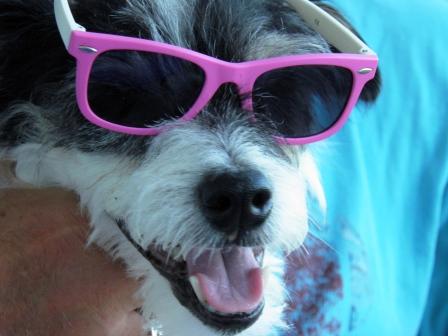
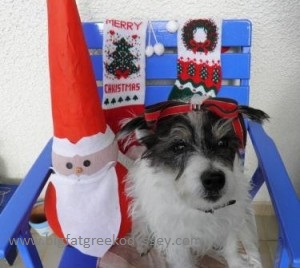
Wallace with santa caption

Wallace in a Greek festive mood

“YOU can’t have moussaka for Christmas,” said one of our English expat friends in the Mani just before our second Christmas in the region, as we discussed festive menus.

“Why not? It seems perfectly reasonable for a Greek odyssey.”

“Okay,” he said with a shrug. “But you can get moussaka any time. Christmas calls for turkey, or at least a chicken. It’s tradition.”

Yes it was, but not necessarily here. Of course he thought we were mad opting for moussaka, but madder still was the whole British faff of trying to replicate Christmas in Greece, with turkeys and even Brussels sprouts. One genial expat who lived full-time in the Mani had bemoaned the fact he had not been able to grow a sprout yet in his garden. If there was one thing I didn’t miss about a British Christmas it was the metallic after-taste of a sprout.

It seemed bizarre to even think of a normal Christmas when some years you can swim until the end of the year  ̶  in the southern Peloponnese at least. And if had been any hotter that particular December we may have plumped for a day at the beach, like some of my teenage Bondi Beach Christmases, when I was growing up in Sydney.

That was because the traditional Christmas in Australia is bizarre as well. I had plenty of those in my childhood from my Scottish family keen to stick to the rules of the ‘homeland’, with turkey or a fat chook (chicken) in 100-degree heat, watching the tree ignite from overheated festive lights, and all the oldies squabbling and then passing out in front of British Christmas reruns on the TV.
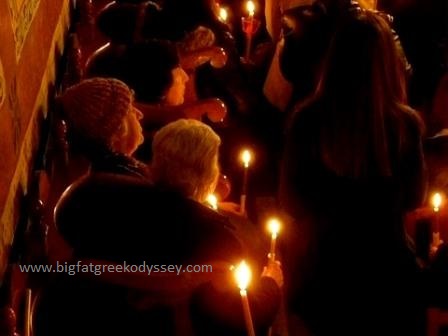
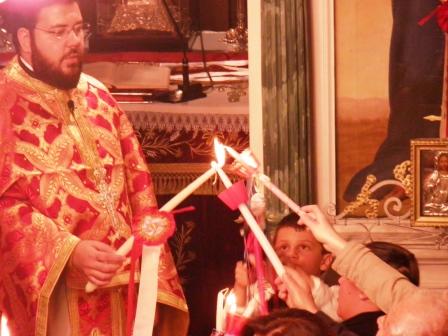
candles in church caption

Christmas in Greece is a quiet time and revolves around family and the church

Christmas in Greece is refreshingly and sensibly low-key, no hysterics, no burn-out. It’s more about family, a time of reflection and religious observation. Greeks do buy presents but they are exchanged mainly on New Year’s Day, which is the feast day of Ayios Vassilis, the Greek version of Santa Claus, without the red suit and reindeer mates.
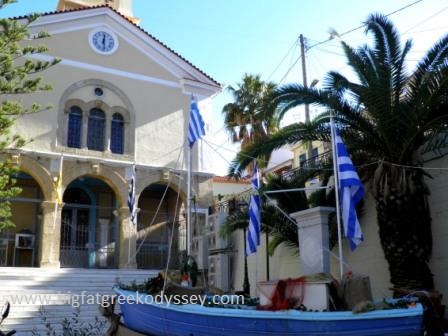
boat at koroni church caption

Villages still opt for the old tradition of a decorated boat like this one in the square at Koroni, Messinia 

Some younger Greeks, particularly in towns, have slowly adopted elements of the western Christmas, and having a decorated tree is something of a status symbol now, despite the economic crisis. However, the old ways remain, especially in villages. You still see illuminated boats in a village plateia because this symbol is associated with Ayios Nikolaos, whose feast day is earlier in December, and he’s the patron saint of sailors. You will also hear kids shuffling about the streets on Christmas Eve singing the kalanda song, a kind of Greek carol which might earn them a coin or a sweet.
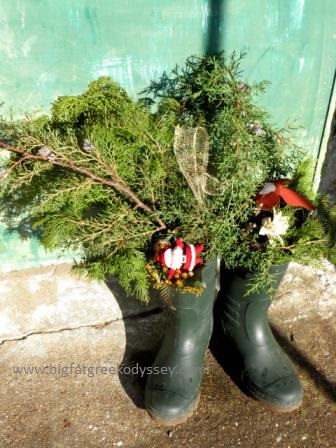
boots caption

Christmas decorations with a rural Greek flavour 

Our first Christmas in the Mani had been in 2010, the year we moved into the hillside village of Megali Mantineia. On Christmas Day there was a morning service, which was hard to ignore as the sound of the chanting rolled out over the entire village. After this, there were quiet preparations for the long family lunch.

In the morning some village friends had brought us gifts of olive oil and kourabiedes (shortbread) with a thick dusting of powdered sugar. We had visited our farming friend Foteini in the morning and took her a small gift. She was having her Christmas lunch with a neighbour Eftihia and her family but, as with most rural Greeks it would be a modest meal, probably roast goat, since everyone here kept goats.

Foteini insisted we come with her to Christmas lunch and it was tempting but we had already accepted lunch with an expat friend further down the Mani. She had recently retired to Greece and perhaps it was an attempt to summon up the familiar, but it was a proper British meal with all the trimmings and plenty of wine. It, too, seemed bizarre and slightly out of place, but at least we could work off the lipid overload by pacing round the nearby olive groves after lunch.

During the second Christmas we were living down the hill from Megali Mantineia in the seaside village of Paleohora. We were renting a house from a genial Greek couple, Andreas and Marina. On Christmas Day, while they stayed at their home in Kalamata for a family gathering, we planned to have a quiet lunch this time, and make the moussaka, for which we had bought all the ingredients. But it was such a gloriously sunny day, despite being cool, that even after all the fuss we had made about the moussaka, we changed our minds.

We drove instead up to Megali Mantineia to have lunch in one of our favourite tavernas, the Iliovasilema (Sunset taverna). The place was open though the whole family was gathered at one long table to eat their lunch of succulent oven-roasted goat and lemony potatoes. There were several other people dining, a few expats and Greek couple from Athens with a house in the village, but somehow we were all annexed to the family proceedings and it turned out to be one of our loveliest Christmases: traditional, with plenty of parea (company) and no fuss.
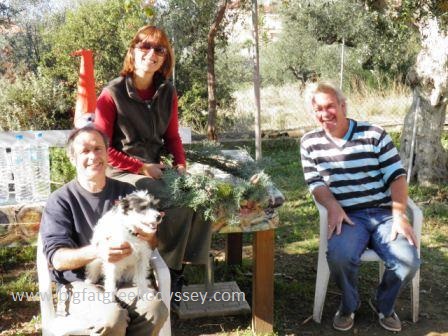
caption hwere

Our lovely Greek landlords in Paleohora, making Christmas wreaths

During our second Christmas in Paleohora, however, we did discover one surprising thing about our landlord Marina. She had a secret obsession for some of the rituals of Christmas and it all started way ahead of the festive season. It became one of the chapters in my sequel Homer’s Where The Heart Is, which, to end my Christmas blog, I would like to share in a small excerpt:

“One Saturday there was a knock at the front door. It was Marina and Andreas. Marina was loaded up with things in baskets and myriad plastic bags hooked over her wrist. I was very afraid though when I saw the big pointed red hat of what appeared to be a papier maché Santa Claus.

“Good morning, I’ve brought some Christmas things. I will just sort them out, yes?” she said.

With her usual proprietorial charm that we had fully accepted now, she barged passed us. I assumed she was taking them to the apothiki (store room) to leave until Christmas. Andreas stayed on the doorstep because his feet were muddy and handed us a bag of sweet oranges from his trees. We stood outside, talking and leaning on the wrought-iron railing on the top steps.  

While we chatted outside we forgot all about Marina. Suddenly I became aware of furious scurrying and hammering going on behind us.

“What’s happening inside, Andreas?”

He rolled his eyes. “Marina has just decorated your place for Christmas.”

“What?”

We turned around and the living room, which had looked atmospheric and Greek, now resembled Santa’s Grotto at a John Lewis store. The big red Santa was on the dining table and tinsel was strung up over the fireplace, with Christmas lights, candle stands and a dozen statues of Santa Claus striking various festive poses.

“Here,” said Marina, pushing two festive woollen socks towards me. “For Christmas Day.”

“But Marina, it’s only November. Too early for Christmas, surely?” I pleaded.

Andreas shook his head. “I agree, Margarita, but Marina loves Christmas, you have no idea.”

Oh yes I did! The living room − lit up and pulsating, lacking only a sound system for Christmas carols − told me so.

“This old place looks better now, don’t you think?” said Marina, hands on hips like the presenter of a TV home makeover show.

One of the things we liked about being in Greece at Christmas was the lack of commercialism and houses lit up like Blackpool seafront. It was a quiet, reflective time instead. But now we had the whole Christmas fizz inside the house. We laughed over it all later and slowly began to dismantle the effects, leaving some of Marina’s festive tat in place and hiding the rest in the apothiki, hoping she wouldn’t notice….”

xmas wally caption

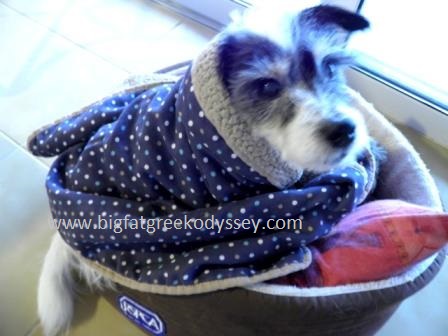
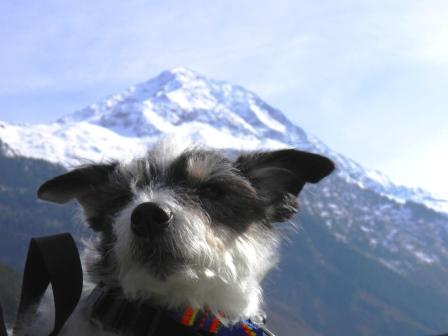
Wallace the lovable Jack Russell sends love and licks for Christmas

Well that’s it for the year. To all readers, I would like to thank you for your continuing interest and support of the blog and my Greek books. I wish you a very happy Christmas and a prosperous New Year. If you happen to find yourself in Greece at Christmas, go for the roast goat every time, or have an Aussie beach Christmas instead.

(Text: © Marjory McGinn)

See you all next year.

Χρονια Πολλα. X

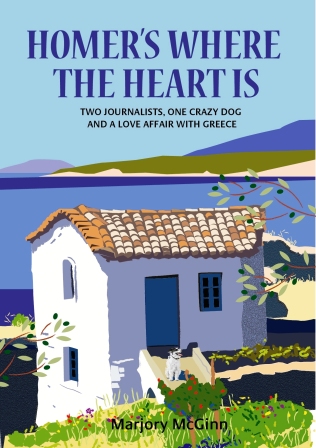
Homer’s Where The Heart Is

TO read more about living in Greece during the crisis in the southern Peloponnese, read my second travel memoir Homer’s Where The Heart Is.

This book is the sequel to the first, Things Can Only Get Feta (published in 2013) about the start of our long odyssey in the rural Mani.
HOMER'S COVER FOR WEB

To those who have already read the latest book, thanks for your kind comments and Amazon reviews, which are always appreciated.

Both books are available on all Amazon’s international sites and also on the Book Depository www.bookdepository.com (with free overseas postage).

On the website  www.bigfatgreekodyssey.com you will also find a ‘books’ page with other information about the books.

To buy either of my books please click on the Amazon links below:

Things Can Only Get Feta

Homer’s Where The Heart Is

You can also find me on Twitter @fatgreekodyssey

And Facebook www.facebook.com/ThingsCanOnlyGetFeta

www.facebook.com/HomersWhereTheHeartIs

Thanks for calling by.

 Protected by Copyscape Web Copyright Protection

© All rights reserved. All text and photographs copyright of the authors 2015. No content/text or photographs may be copied from the blog without the prior written permission of the authors. This applies to all posts on the blog

Facebooktwitterredditpinterestlinkedinmail
Please share this post

Is a dream life in the sun the high road to happiness?

Caption here for Marjie and Jimmy and Wally

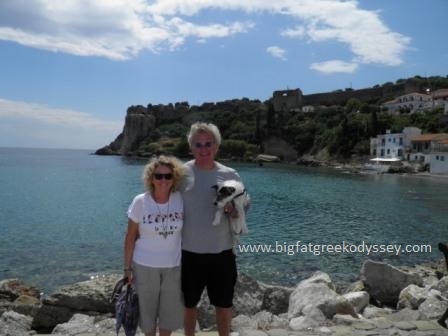
Marjory, Jim and Wallace the Jack Russell terrier in front of Koroni castle, Messinia

BEFORE Jim and I set off on our mid-life adventure to Greece in 2010, a friend commented on our plan with a yearning look in his eyes. “I can only wonder what it must be like to divest yourself of everything and take off into the wild blue yonder.”

As a successful professional with a lovely house and two young children, his comment was motivated mainly by a wish to be free of nine-to-five pressure for a while, nothing more complicated than that.

But many other people said very similar things as we moved closer to our departure date. One professional guy, stuck in a difficult job and with children to support, asked me rather sadly: “Where is our mid-life odyssey? When can we do what you’re doing?”

I felt for his predicament. “You can do it one day if you really want it badly enough” was all I could offer him. But it did become our kind of stock answer to these unexpected comments, because that statement had been true for us.

We had put in a huge amount of planning and time into the proposed odyssey, putting our personal possessions in storage, renting out our house in Scotland, as well as all the nagging issues involved in leaving the UK for a while. Our to-do list before we left was four A4 pages long. But not once did we doubt we were doing the right thing, even though Greece was moving into the first stages of its economic crisis.

Caption here for castle in Ochils

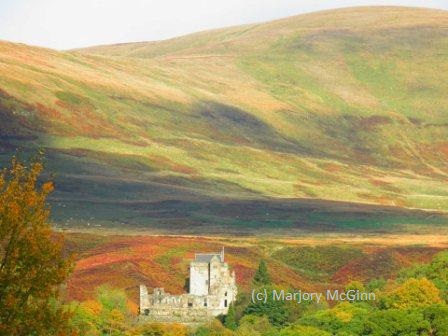
Castle Campbell in the spectacular Ochil hills above our former village in Scotland

We wanted it badly enough, but we didn’t seek out the odyssey because we hated our lives, or where we were living, which was in fact a very picturesque village outside Stirling. We just wanted to live for a while under a “wandering star”. And who doesn’t?

Sadly, the subtext to a lot of the comments we heard over and over again were that many other Brits were desperate for an overseas odyssey, or in some cases a permanent move abroad, because they were innately unhappy and they believed life would be happier if only they were some place else.

But is this true? Can your life be happier just because you change location, particularly to a warm sunny country like Greece, for example? I don’t think so. It will be different, for sure, but not necessarily happier, or better.

Caption for Koroni harbour here

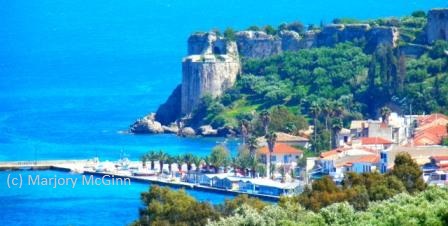
The lovely harbour of Koroni where we spent the last year of our Greek odyssey 

caption for taverna here

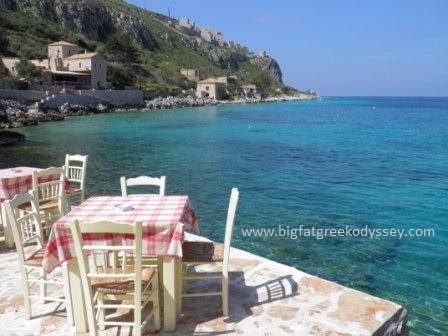
A taverna by the water at Limeni Bay, the Mani. The casual Greek lifestyle has a massive pull for foreigners

Our years in Greece brought us in contact with a lot of British, American and other expatriates, who told us they came to live in Greece to ‘escape’ their old, humdrum lives. Many of them obviously thrived in the gorgeous climate with a better lifestyle than they had back home, particularly the Brits, as if they were permanently on holiday, and no-one should blame them for wanting easier lives and sun and sea.

Many confessed to being happier in their new location, and said it was the best move they had ever made. However, those who sought Greece for a particular reason rather than the expectation of being happier, were probably the most successful resettlers, especially those who managed to assimilate well.

The American artist and writer Pamela Jane Rogers, who has written a fascinating memoir Greekscapes: Journeys With An Artist, left America after the break-up of her marriage and ended up settling on Poros island. She has been living there for 26 years. Mostly, she came to Greece for its beauty and as an inspiration for her painting. She has built up a great reputation for her work worldwide and is thriving in Greece. www.pamelajanerogers.com

The Scottish crime writer Paul Johnson has lived in Greece for some years, which has been the inspiration for many of his novels. Many other writers and artists also find that Greece provides a sunny muse and have no intention of leaving, despite the crisis.

caption here for tsapi beach

Tsapi cove, Messinia. Who can resist the lure of enless sun and sea?

But a move to Greece is not always the answer to everything. Some British expats told us that although their lifestyle was easier, they weren’t as happy as they thought they’d be. The same problems that plagued them back home, plague them in Greece, as well as the fact that in Greece there is no financial safety net, a poorer health system, and their extended families are not around for support.

Many of those who escaped to Greece have ultimately returned home.  One British expat I interviewed in 2010 for a freelance story about Greece had gone there with her husband where they built their ‘dream’ home near Kalamata, only it turned out to be anything but. It was planned as a retirement home, but after a heartbreaking series of bungles with builders, bureaucracy and other disasters, they sold up and moved back the UK, and have no further plans to pursue a dream life abroad.

Wally on sunbed caption

Wallace our Jack Russell enjoying life as a Greek beach bum

Perhaps it shows that you can’t ramp up happiness just by changing location. It’s something deeper, more intrinsic. There’s a line in a poem by famous Greek poet Konstantinos Kavafis which sums it up. It loosely translates as: “You can change your skies but not your soul.”

To a great extent that’s true. The old life will follow you about wherever you go. A broken heart will be a broken heart wherever you are. A failure to relate with others, or to feel fulfilled on many levels, won’t change just because you go to Greece, or another sunny location.

The Greek/American travel writer Matt Barrett, who has an informative and popular Greek travel website www.greecetravel.com also had similar thoughts recently on his blog, written while on the island of Lesvos. In many ways he inspired me to write this piece.

Having lived for many years in Greece, he made this astute comment about those who want to leave their old life and move there: “The truth is that you only think you want to throw it all away and move to Greece because you are not taking the time to appreciate the things you have that you would absolutely miss if you did … If you are happy, with yourself then it does not matter if you are in Greece or Nebraska.”

The search for happiness is only part of it, of course. People are seeking different things when they go to Greece, and sometimes it’s not all that straightforward. It was one of the themes of my second travel memoir, Homer’s Where the Heart Is, after a Greek businessman had posed a question to me at a village celebration in the Mani. Apart from sun and sea, he asked, “what is it you (foreigners) seek to find in our country that you cannot find in your own?”

It’s not an easy question to answer and it is one of the things I thought about a great deal while in Greece, the illusive thing we are seeking there, and I am not sure I’ve really found it yet. Or that it can be found.

We went to the southern Peloponnese for a year and ended up staying for four. Although we never went seeking greater happiness and contentment I think we were unintentionally happier overall, despite the fact that not all our experiences were positive. We didn’t always get things right. We had tough times in the crisis, like everyone. We found it hard adjusting to another culture, and in our case a very traditional rural culture in the hillside village of Megali Mantineia. We found it tough renting abroad, without all the comforts and security we take for granted in Britain.

But in the end, we went without any illusions or expectations and we were constantly surprised and delighted by everything we found, helped in no small part by the wonderful Greeks we met (and occasionally expats, too), who shared their lives and their stories. Because we never sought happiness in a different location, I believe we found it and that may be the only thing I learnt after four years in Greece.

The place really isn’t the thing. It doesn’t set the agenda I believe.

The expat I mentioned earlier who built her dream home near Kalamata later told me that when she returned to the UK she realised perhaps for the first time what positive things the country had to offer her. So her story really did have a happy ending but not in the way she expected.

Of course, I’m not saying, don’t go abroad to search for the dream life, or have a long adventure – especially in warm and welcoming Greece, and even though it is still in crisis. But don’t go expecting it will change your life forever. As Kavafis indicated, it may only change your ‘sky’ and nothing more – unless that’s really all you want.

Travel Memoirs

TO read more about living in Greece during the crisis in the southern Peloponnese, read my travel memoirs, Things Can Only Get Feta, Homer’s Where The Heart Is and A Scorpion in the Lemon Tree.

The books are available on all Amazon’s international sites, Barnes and Noble and also on the Book Depository www.bookdepository.com (with free overseas postage). On the website  www.bigfatgreekodyssey.com you will also find a books page with other information about the books.

New Book

Marjory has just published a debut novel, set in southern Greece, called A Saint For The Summer. This is a contemporary tale with a narrative thread back to the Second World War, a “tale of heroism, faith and love” described by a recent reviewer as “entertaining, enthralling”. For more information, see the books page link, above.

The book is available on all Amazon sites.

A Saint For The Summer 

If you have liked my books please think of adding a small review on Amazon sites which is always very welcome. Thanks for calling by. x

You can also find me on Twitter @fatgreekodyssey

And my books page on Facebook www.facebook.com/ThingsCanOnlyGetFeta

 Protected by Copyscape Web Copyright Protection

© All rights reserved. All text and photographs copyright of the authors 2010 to 2018. No content/text or photographs may be copied from the blog without the prior written permission of the authors. This applies to all posts on the blog


Facebooktwitterredditpinterestlinkedinmail
Please share this post

Why we must keep the spirit of old Greece afloat . . .

OLYMPUS DIGITAL CAMERA

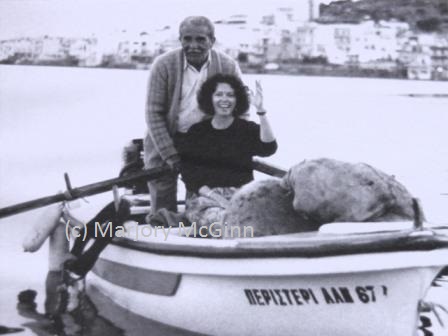
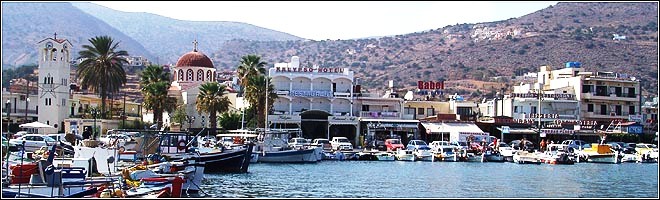
Marjory being rowed about Elounda harbour by a kindly local during a long sabbatical in Crete, 1989

AS someone who has been going to Greece all my life, since the 1970s, the political events of the past few months have saddened me. I am wondering, along with everyone else, how Greece’s economic situation and its politics ever got so convoluted.

In recent months the scenario has included punishing negotiations for a new bailout; a referendum called by PM Alexis Tsipras, who then ignored the results, as well as the 65 per cent of Greeks opposing austerity; a new and terrifying agreement signed with the Troika; a mutiny by some Syriza MPs; Tsipras’s resignation; a September election tipped; a new breakaway leftist party. There have been frenetic political twists and turns, like a manic rollercoaster with brake failure. Most Greeks claim to be confused now.

As one of my Twitter followers, a Greek teacher, recently said: “I don’t know which way is up or down any more? Worse, I don’t know which way is right or left.”

Many others are devastated. A female friend in Athens, with a young son, wrote to me recently, saying: “We feel that we are on a boat that’s sinking. We don’t know what comes next and we are trying to live from day to day.”

She also believes, as someone who works as an economist in the city, that the country will change drastically in the coming years after the next bout of austerity and the fire sale of assets.

I too have had a feeling of dread for months that we are witnessing the last carefree days of the Greece that we all used to know and love. I hope my Athens friend is wrong, but in my heart I fear she is right. Change is coming!

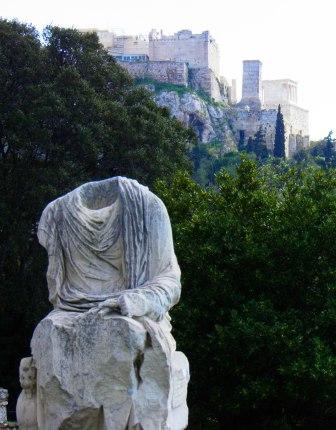
No head for heights: The statue at the Ancient Agora in Athens

A headless statue in the Agora, Athens seems to say more about the troubled present day city that it does about the past

I have been in love with Greece all my life, from the early 1970s on my first trip, not long after high school in Australia, when I arrived in Athens for a short break and ended up staying for a year’s working holiday. Despite the fact Greece was then ruled by a military dictatorship, and it was yet another tragic time in its history, in other ways it was, culturally and socially at least, a time of simplicity, even innocence, compared to now.

All the elements of Greek life and culture that philhellenes still love were there in abundance. I wrote about this time in Athens as a parallel narrative in my book Homer’s Where The Heart Is. When I first arrived in the city and stepped off the overland bus from London it was love at first sight: “It was nothing I could easily define, but more a fusion of disparate things, all maddeningly exotic to my young mind: the incomprehensible street signs, the old people dressed in black, the coffee shops, the bakeries wafting aromas of freshly baked bread and tiropites, and all the other smells even the bad ones – fetid drains and a city still staggering after a long summer heatwave. It all blended into a heady Levantine cocktail.”

I have had many trips to Greece since, some for just a few weeks’ vacation, but many were quite long, from a few months to my recent four-year odyssey in southern Greece.

caption with artemis

Jim and Marjory with their friend Artemios on a trip to Santorini in 2002

When I remember the earlier trips, I feel so much nostalgia for that old Greece, whether it was in Athens or places of unique beauty like Santorini, or small unspoilt islands like Serifos, Sifnos, Paxos, Patmos and for a way of life that was simple and charming, where donkeys were more common than cars and you could only buy your yoghurt in ceramic bowls, where there was only one kind of coffee, Nescafe, and where the drachma still reigned. Joining the Eurozone was a futuristic folly. Despite not having much money, most people seemed happier, and were fantastically hospitable.

In 1989, I took a sabbatical from my newspaper job in Sydney and went to Crete for two months. It was totally unplanned, no itinerary, no rooms booked in advance. I took a boat from Piraeus to Irakleion and travelled to the Venetian town of Hania. I hadn’t planned getting sick either, but a stomach bug left me stranded in a harbourside hotel for days, where a doctor had to be summoned.

caption for elounda  pic by www.dilos.com

The harbour at Elounda in Crete, some years after Marjory’s first trip. Picture courtesy of www.dilos.com

Later on, a chance recommendation from a fellow Aussie made me seek out a convalescence of sorts in Elounda, a small undeveloped fishing village then on the north-eastern coast of the island. Too weak to bother with buses, I got in a taxi and asked the driver to take me to Elounda. It didn’t seem strange to the driver that when we got there, I hadn’t anything booked. Don’t worry, he said kindly, we’ll find you something. It was October after all and not bursting with tourists, not back then anyway.

Near the harbour he stopped the car, but before he started scouting for rooms, a small rotund woman rushed out of her house, towards the taxi. Did I want a room, she asked me.

The taxi driver waited patiently while I followed her inside to see the small apartment (a bedroom, bathroom and tiny kitchen) on the ground floor. It was simple and clean. I took it on the spot, the taxi driver was dispatched, happy with his healthy fare and tip. That was the start of a wonderful stay in Elounda, and a friendship with the couple upstairs, Poppy and George, with whom I practically lived for the rest of my stay, watching their TV,  sharing meals, helping Poppy to prepare some of them. I would often sit on her upstairs balcony with a few neighbouring women, chattering and cleaning mountains of horta (greens) just collected from the hills.

The couple also took me out on their small boat, the Peristeri, for local excursions. Once they took me fishing at 5am to the nearby island of Spinalonga, before Victoria Hislop had been inspired to set her book The Island there, about the former leper colony. When I went it was just a rather ruined and forlorn outpost.

The rest of the time in Elounda, I rambled the hills behind the village, often with Poppy, often alone, and everywhere I went people invited me in for drinks, coffee, meals, parea, company. When I finally left, Poppy and George hugged me and told me I must stay in touch as if I were a long-lost relative.

Greeks were like that then. And they still are in many parts of the country, especially in the islands and rural places like the southern Peloponnese, where we spent four years from 2010, living the first year in a remote hillside village in the Mani and later in Koroni, at the tip of the Messinian peninsula. In these areas we were shown the same warmth and familiarity by locals, as Poppy and George.

caption of old boys

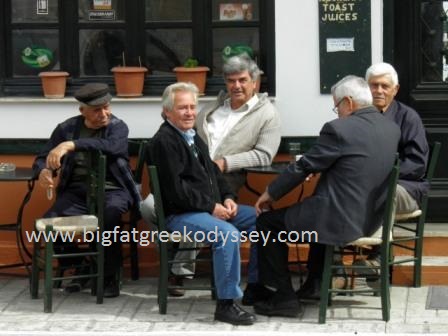
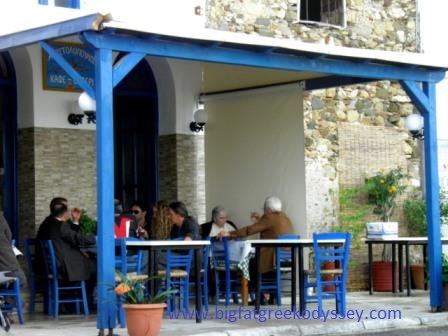
Some of the regulars in one of Koroni’s surviving old kafeneia in the main square

OLYMPUS DIGITAL CAMERA

caption for tassos sipsas in shop

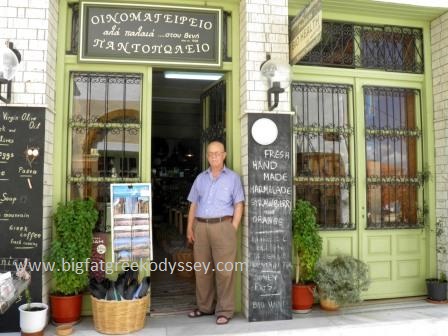
An old traditional shop in Koroni, a pantopoleio, on Karapavlou St, selling everything from wine to organic food and owned by the charming Tasos Sipsas

But Greece as a country has been slowly changing, of course. How could it not? It’s not a folk museum, after all. It has become more modern, European, apart from the plumbing, which remains antique! And inevitably, many of the old cultural elements are changing or disappearing. Fewer rural Greeks wear traditional clothing now. There are fewer kafeneia and ouzeries in villages than there used to be; there are fewer working villages. In the Mani we found that many wonderful hillside villages that were once full of life, shops and schools, were now inhabited by only a dozen or so locals. In many it was hard to find even one kafeneio or local store.

caption for barber

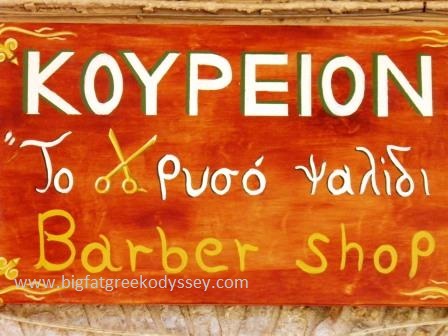
A folky and humorous sign for the local barbers, the Golden Scissors, in Koroni

With the drastic economic changes and cuts that are coming, will too much of Greece’s traditional life and customs change irrevocably, to squeeze Greece into a rule-bound northern Europe template? Trouncing all the features that, ironically, tourists go to Greece to experience?

I think that’s something that everyone with any ounce of love for Greece should fight against. We must save the spirit of old Greece, its personality, its old customs and crafts, and its ideals of friendship and hospitality because, as so many other countries have found, once you dismantle a country’s soul and the uniqueness of its past, you can never really get it back again. No-one who has travelled to Greece from the 1960s onwards could come to terms with that loss. Not least the inimitable Greeks themselves.

HOMER'S COVER FOR WEB

Homer’s Where The Heart Is

TO read more about living in Greece during the crisis in the southern Peloponnese, read my new travel memoir Homer’s Where The Heart Is. This is the sequel to the first, Things Can Only Get Feta (first published in 2013) about the start of our long odyssey in the rural Mani.

To those who have already read the latest book, thanks for your kind comments and Amazon reviews, which are always appreciated.

Both books are available on all Amazon’s international sites and also on the Book Depository www.bookdepository.com (with free overseas postage). If you are in Greece you can inquire about having the book ordered at your branch of the Public store www.public.gr

If any readers have queries about availability for both books, please contact me via the contact page on our website www.bigfatgreekodyssey.com where you will also find a ‘books’ page with other information about the books.

To buy either of my books please click on the Amazon links below:

Things Can Only Get Feta

Homer’s Where The Heart Is

You can also find me on Twitter @fatgreekodyssey

And Facebook www.facebook.com/ThingsCanOnlyGetFeta

www.facebook.com/HomersWhereTheHeartIs

Thanks for calling by.

 Protected by Copyscape Web Copyright Protection

© All rights reserved. All text and photographs copyright of the authors 2015. No content/text or photographs may be copied from the blog without the prior written permission of the authors. This applies to all posts on the blog.

Facebooktwitterredditpinterestlinkedinmail
Please share this post

Why the EU must embrace the Zorba philosophy

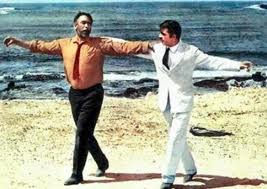
Anthony Quinn as Zorba, with Alan Bates, dancing the sirtaki in the 1964 movie

Anthony Quinn as Zorba, with Alan Bates, dancing the sirtaki in the 1964 movie

THE events of the last few weeks, as Greece has fought for a new bailout deal, have left us all in shock. They have shown us how oppressive and vindictive the EU can be and, in contrast, how spirited and stoical the Greeks are when under attack and fighting for their lives.

I don’t want to add any more to the voluminous public discussions. Greater minds than mine have debated all the political/economic issues of the crisis. As someone who loves Greece, I can only pray there will be a good outcome for the country, despite more austerity piling up against it.

What I have gathered from watching recent events unfold – the June referendum and then EU leaders, particularly Germany, acting like schoolyard bullies – is this: most Europeans don’t really understand Greeks, or their culture. It’s as if few of them have ever been to Greece.

What EU leaders have tried to do is shoehorn the Greek character into a northern European template. It won’t go; it never will go. It’s ham-fisted and almost laughable. Greeks have a different story, a different history and cultural influences. Greece is still the least European country in Europe, still leaning gently towards its old Levantine influences, which makes it the exotic, appealing, often chaotic and, sometimes, maddeningly different place that it is. But we wouldn’t have it any other way.

our friend artemis

A favourite old friend, Artemios, from Santorini typifies the Greek character: generous, maverick and an expert at skinning prickly pears

caption here

Wonderful, vibrant villagers from Megali Mantineia, where we lived in the Mani from 2010

Greeks will never be cool-headed, flinty, northern European clock-watchers, which is why generations of foreigners have flocked to Greece for respite. Apart from its physical beauty, Greece still has the human touch, which is something that has been lost in many parts of Europe, and the UK as well, to a degree.

Greeks have not been blameless in the way they have handled their economy, but I believe that it’s basically because they are different from their northern partners, their character has come in for a battering. They have been labelled as lazy, work-shy and corrupt, and these clichés have been echoed unfairly throughout much of the international media.

There is corruption, of course, as there is in every country, and there are complex reasons for it, but I believe that due to a weaker and not very independent media, the corruption and excesses of past governments have not been exposed as they might have been in western countries. Only now are we seeing more transparency in Greece, and the internet and social media has helped to expose wrongdoing where some of the press has not.

We forget that Greece has only recently emerged from a devastating series of occupations and political upheavals: 400 years of Turkish occupation; the punitive  German occupation of the Second World War and the Greek civil war it spawned, and a disastrous military takeover in 1967 with a regime that lasted until 1974.

Four decades of relative calm since the 1970s is but a drop in the ocean for a country to re-invent itself. Until recent weeks, at least, the economic crisis was just another upheaval that Greeks have had to cope with.

During my time in Greece, I have found Greeks are among the hardest working people in Europe. In the last five years I met countless people, especially in the restaurant trade, who work more than 12 hours a day, seven days a week from May to October and in many areas like the Peloponnese will then do a long olive harvest in the winter.

fgoteini on donkey

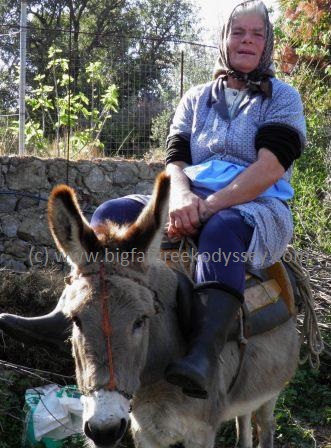
Greeks are bred tough like Foteini, a ‘traditional woman’ from the Mani

Foteini, one of my farming friends in the Mani, who features prominently in both my books, is an unforgettable character and the toughest woman (a pensioner!) I’ve ever met anywhere. She harvests olives from her 200 trees, alone, every year, without fail, and rears a few goats to supplement her paltry farmer’s pension of 300 euros a month, which has been cut back since 2011. No pensioner in the UK would live like Foteini.

Not only have the Eurocrats tried to reinvent the Greek personality but they have also asked for the impossible, for a country to change its system overnight.

Andreas, one of our Greek friends in the Mani, who I wrote about in my second memoir Homer’s Where The Heart Is, put it this way during a discussion about the crisis in 2012, and I quote from the book (chapter 20): “The Troika moans at us… they say we don’t make changes fast enough in the government, and with taxes… but they want us to change centuries of customs and business in a few months. We cannot do it! Impossible!”

The recent events have proved him right. Impossible, and heartbreaking!

After a lifetime of visiting Greece and after four years living in the southern Peloponnese, most recently Koroni, in Messinia, I do not recognise many of the criticisms and cliches levelled at the Greeks. And nor do I feel they deserve the excruciating contempt and hatred that has been slung at them during the crisis.

Perhaps the main fault of ordinary Greeks (and not the dynastic elites or the shipping magnates) is not just making a mess of their fiscal spreadsheets, but in not putting money first in the way that other societies in the west do. In my opinion, this is a country that has put life to the fore, and people, with a belief in leventia (generosity of heart), parea (company), kefi (high spirits) filotimo (sense of honour).

I have found Greeks to be the kindest people I have ever met. When we lived in Koroni for a year, we befriended a couple who had a small holding (with a few goats and chickens) near to where we lived. Tasos and Eleni are warm-hearted and interesting people, whom we saw regularly and became fond of, along with their lovely family.

caption here

Gifts to strangers and hospitality, filoxenia, is alive and well in Greece

One day, after their long olive harvest, they arrived at our house with a big basket full of gifts from their farm: olive oil, olives, capers, goat cheese, herbs, and a bottle of their homemade wine (above). They simply wanted to show us hospitality, filoxenia, and make our stay more pleasant. We were overwhelmed by this gesture of friendship. It’s not the first time I’ve experienced this in Greece. Whether Greeks are in crisis or not, they never lose this generosity, or their indomitable spirit. The Zorba factor.

I believe it’s not Greeks who need to change radically, it’s the ‘other’ Europeans. They need to thaw and become more like the Greeks; get in touch with their inner Zorba. Perhaps then they’ll understand Greeks a bit better, offer a more reasonable fiscal blueprint for the future. And create a more compassionate EU.

As Nikos Kazantzakis, author of Zorba the Greek, wrote: “A man needs a little madness in his life!”

The Eurocrats need to kick off their shoes, find a beach and dance on it. Opa!


HOMER'S COVER FOR WEB

Homer’s Where The Heart Is

TO read more about living in Greece during the crisis in the southern Peloponnese, read my new travel memoir Homer’s Where The Heart Is. This is the sequel to my first memoir, Things Can Only Get Feta (first published in 2013) about the start of our three-year adventure living in the rural Mani.

To those who have already read the latest book, thanks for your kind comments and Amazon reviews, which are always appreciated.

Both books are available on all Amazon’s international sites and also on the Book Depository www.bookdepository.com (with free overseas postage). If you are in Greece you can inquire about having the book ordered at your branch of the Public store www.public.gr

If any readers have queries about availability for both books, please contact me via the contact page on our website www.bigfatgreekodyssey.com where you will also find a ‘books’ page with other information about the books.

To buy either of my books please click on the Amazon links below:

Things Can Only Get Feta

Homer’s Where The Heart Is

You can also find me on Twitter @fatgreekodyssey

And Facebook www.facebook.com/ThingsCanOnlyGetFeta

www.facebook.com/HomersWhereTheHeartIs

Thanks for calling by.

 Protected by Copyscape Web Copyright Protection

© All rights reserved. Text and photographs copyright of the authors 2016. No content/text or photographs may be copied from the blog without the prior written permission of the authors. This applies to all posts on the blog.

Facebooktwitterredditpinterestlinkedinmail
Please share this post

You’re never a lost soul in Greece . . .


Caption here for Marjie at door

Marjory in one of the old doorways of Mistraki

WE were recently invited to a village church on a Sunday morning by a local papas (priest), who promised there would be a lovely service. The church of Ayia Triada was celebrating the national feast day of the Holy Spirit (To Ayio Pnevma), which is part of the important Pentecost period in the Greek Orthodox Church.

We’d never visited the old and rather remote village of Mistraki, though we knew roughly where it was, and planned to get there by 8.45am for the last hour of the service. It was a pleasant drive on a sunny day up through the hills, where there are only a few scattered villages, with views down to the Messinian Gulf.

Caption here for Mistriki old house

The splendid house of well-known, 19th-century resident Martha Kypriopoulou-Boziki 

When we got to Mistraki, however, the village seemed deserted. Not a soul about, apart from two huge dogs lying across the dusty road. All the houses were shuttered and there was no church in sight, or even a kafeneio. No signs of life.

We parked the car and walked about from one end of the village to the other. It’s a tiny place with lovely old houses, mostly dating from the early 18th century. Many have been restored to their original glory but a few others lie in ruins. But where was the church?

It was past 8.45 when we began to walk up dirt tracks out of the village, looking for signs of a church dome peeking up from the trees, listening for the sound of chanting, but every path yielded nothing but more houses and goat farms. This was curious. Had we got the name of the village wrong? Was the church hidden deep in the fold of a hill?

After nine o’clock, we were still wandering about, convinced that having come all this way we would miss the service, and the small yiorti (festivity) we anticipated afterwards. We were disappointed.

“Let’s hope the Holy Spirit’s looking out for us and we’ll get a sign,” said Jim, more in a jokey, bantering way, as on our long odysseys in Greece we’ve always tried to make light of most difficulties we’ve encountered along the way, big and small. We trudged around a bit more. It was getting hot and we decided we’d have to give up soon and retreat.

Jim suddenly stopped and cocked his head slightly. “I can hear a tractor in the distance.”

Caption for dog sleeping near hoose

There was a dog-tired, High Noon feel to the hillside settlement of Mistraki 

He started running through the village, waking up dozing dogs and scattering dust, with me trotting on behind, trying to keep my best sandals from disappearing down potholes. Sure enough, I could hear it too and we sprinted up to the ‘main’ road just as a tractor with two men on board was rumbling by. We shouted and waved our arms, and thankfully the tractor stopped. The two men looked amused when we asked where the church was.

“It’s just through there,” said one guy in overalls, “Five minutes’ walk away.”

Caption for church

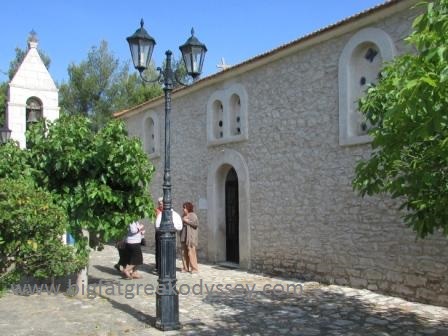
The church of Ayia Triada celebrating the feast of the Holy Spirit (Ayio Pnevma)

They directed us to the one dirt road we hadn’t tried yet, unsignposted, but with the remains of an old spring water outlet on the corner, which should have alerted us to a church nearby.

We thanked them and rushed along the track until the church appeared, in a clearing amid tall trees. The faintest sounds of chanting reached us now. We were late, but all was far from lost.

“Well Marj!” said Jim. “Did the Holy Spirit come to the rescue or what?”

I laughed. “Probably! It was a nice touch though, wasn’t it, sweeping in on a tractor. Very appropriate.”

Caption for icon

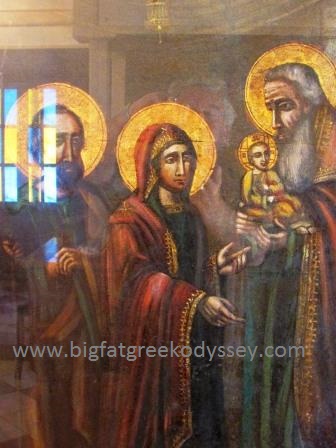
One of the icons of Ayia Triada, depicting the presentation of Christ at the Temple 

We burst into the church, a bit out of breath. Heads swivelled our way, and we were surprised to find a big turnout of locals in this old, restored church, with some lovely icons. And Papa Theodoros, dressed in his ornamental robe, was in fine voice, particularly at the end of the service, offering a spine-tingling crescendo to the chanting.

Papas caption

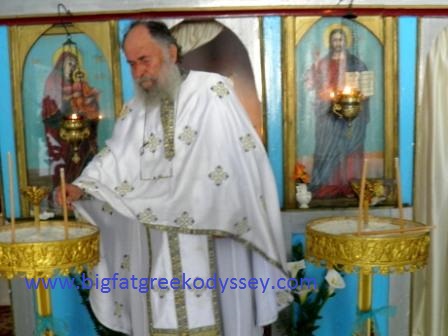
Genial Papa Theodoros, the main priest for the large rural community north-west of Koroni

This is an important service and celebration, coming on Monday, June 1, the day after the Pentakosti, the Pentecost, which falls 50 days after Easter Sunday and commemorates the descent of the Holy Spirit on Christ’s disciples.

After the service, the congregation gathered in the forecourt. These were locals, from several outlying villages too, who were among some of the friendliest people we had met in this part of Greece, near Koroni. They wished us ‘chronia polla’ (many years) and a good month, ‘kalo mina’. They were chatty and keen to know where we were from and what our impressions were of Greece. They were at least able to explain why Mistraki seemed deserted. There are now, sadly, only seven permanent residents left in this village, and they were all at the service.

Porky pig caption

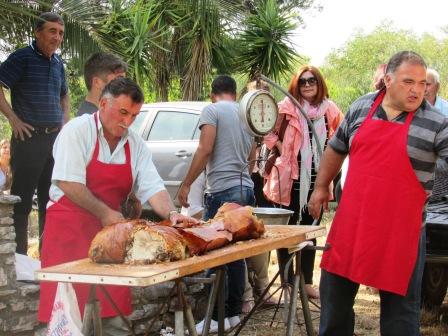
Spit roasted pork is traditional for local celebrations in this part of southern Greece 

At the edge of the forecourt, two men had set up a trestle table, with a whole roast pig on top, complete with head, and carved into chunks, and a set of scales nearby. The meat was not all destined for this venue, however, as the pair with their ‘roaming roasts’ would visit other locations that day for other yiortes.

The air was full of the succulent aroma of spit-roasted meat, yet there were no other signs in the forecourt of a yiorti – chairs, tables, or drinks – until the papas came rushing out of the church, dressed down in his black robe and, curiously, carrying a bulging plastic bag.

Elate,” he called to us, with a wave, herding us towards a low stone wall under the trees. Perhaps because we were foreigners, ‘guests’, we were asked to sit down first and the papas unscrewed a large plastic bottle filled with local,  honey-coloured wine and put a liberal dash in our plastic cups.

There was a lot of banter and laughter from the rest of the congregation behind him, watching as he pulled things from his bag: chunks of bread, sweet tomatoes, and goat cheese, paper plates, serviettes. Someone was summoned to collect a huge chunk of roast pork, wrapped in thick paper. It was placed on the wall and opened up for everyone to help themselves, and the wine was shared around.

It was an impromtu feast, and one of the nicest yiortes we had been to for its spontaneity and warmth, and its Biblical simplicity. Papa Theodoros is like no other priest we have met in Greece, and we were introduced to him months earlier while trying to find the key holder for a local Byzantine monastery. He is warm and approachable and has a nice sense of humour.

Although in his late 60s, I would guess, he would also be one of the hardest working priests in this area, with three or four churches to preside over, as well as a nearby monastery. Due to cutbacks during the economic crisis, few retiring priests are ever replaced in villages.

Caption here

One of the colourful touches in the village

The time had passed all too quickly and people left with kind wishes for the rest of our stay in Koroni.

Tou chronou, next year,” they said, a common expression meaning that we would hopefully all do the same again next year.

Indeed, I think we will. Next time, we may be less in need of the Holy Spirit, at least on church-finding missions.

HOMER'S COVER FOR WEB

Homer’s Where the Heart Is

To read more about village life in the southern Peloponnese and how the economic crisis has impacted on Greece, read my new travel memoir Homer’s Where the Heart Is. This is the sequel to my first memoir, Things Can Only Get Feta (first published in 2013) about the start of our three-year adventure living in the rural Mani.

To those who have already read the latest book, thanks for your kind comments and Amazon reviews, which are always appreciated.

Both books are available on all Amazon’s international sites. However, several Greek friends and readers have asked about buying the latest book in Greece. Apart from Amazon and the Book Depository www.bookdepository.com (with free overseas postage), Homer’s Where the Heart Is is not currently in bookshops in Greece.

However, if you inquire at any Public bookstore www.public.gr (some of which stock Things Can Only Get Feta), you may be able to arrange for the store to order the paperback from Amazon. And some independent bookstores will also do the same for you. I will offer more advice on this in the months to come.

If any readers have queries about availability for both books, please contact me via the contact page on our website www.bigfatgreekodyssey.com where you will also find a ‘books’ page with other information about the books.

I have had some very favourable comments also about the design and layout of Homer’s Where the Heart Is and for that I would like to thank the expert skills of ex-journalist Jim Bruce. Jim’s book editing and formatting operation, called ebooklover www.ebooklover.co.uk can help both indie authors and those seeking publishers. Jim can get your manuscript ready and in perfect shape for presenting to publishers, which is a great help in this highly competitive publishing market right now.

To buy either of my books please click on the Amazon link below:

Things Can Only Get Feta

Homer’s Where The Heart Is

You can also find me on Twitter @fatgreekodyssey

And Facebook www.facebook.com/ThingsCanOnlyGetFeta

www.facebook.com/HomersWhereTheHeartIs

Thanks for calling by.

 Protected by Copyscape Web Copyright Protection

© All rights reserved. Text and photographs copyright of the authors 2015. No content/text or photographs may be copied from the blog without the prior written permission of the authors. This applies to all posts on the blog.


Facebooktwitterredditpinterestlinkedinmail
Please share this post

Don’t drive yourself mad in Greece …


caption here please

Driving in Greece can really get your goat

I HAVE come to the conclusion that the only way to deal with the nervy business of driving in Greece, with poor roads and maverick drivers, is to treat it as a metaphor for life itself.

Focus on the scary, I’m-about-to-die moments as they come up and don’t obsess over the whole, long journey, or you’ll never set out.

Take it all one deep, crumbling pothole at a time.

koroni caption here

Koroni harbour with the Taygetos mountains in the background

I thought of this the other day when I had a long 50km drive from Koroni, at the tip of the Messinian peninsula to Kalamata, for a few early appointments. The road from picturesque Koroni is long and narrow, twisty in parts and used by tractors, pick-up trucks, buses, and all kinds of crazy drivers. It has poor edges in places, where the road sheers off on to deep drops, with no guard rails.

petalidi market caption

No driving through on market day at Petalidi

It also winds through two large villages with bottlenecks at intersections and is a nightmare on the laiki, market, days, and in summer, where the narrow roads are log-jammed with tour buses, camper vans, tractors and gypsy hawkers in pick-up trucks crammed with fruit and veg, the watermelons regularly bouncing off and splattering on the road.

boat caption here

A typical sight from the road that winds along the coast from Koroni to Petalidi in the Messinian peninsula

Of course, it isn’t always hell. There are a few calm days, and if you can ever relax for a moment, the views along this road are gorgeous, looking across the Messinian gulf towards the Mani and the Taygetos mountains, with Kalamata city spread along the head of the Messinian gulf. There are moments when you glance at this beautiful region and remember why you’re in Greece to start with, but you can never take your eyes off the road for more than a second. Around every corner is the outrageously unexpected, and the close shave, of which we’ve had many.

This is what I saw on that one morning driving to Kalamata: drivers overtaking on blind bends and coming straight for you (very normal); pick-up trucks loaded with goats in the back (normal, though sometimes its donkeys and horses); one driver hogging a whole busy stretch of road while a police car desperately needed to overtake. The driver wouldn’t budge (Greek rebel, very normal). Luckily for him, he wasn’t later pulled over by the cops. I’ve seen similar with ambulances trying to overtake on life-saving missions.

That morning I also saw a motorbike rider with no helmet (very normal) weaving about and awkwardly carrying a large wrapped package under one arm; a couple on another motorbike with two children sandwiched on the seat between them (no helmets) and at least one farmer walking along the road trailing four skittery goats on ropes. There are animal hazards aplenty on Greek roads, including runaway chickens, and once I had to dodge a horse cantering down the road with no rider or escort.

kardamili caption

Spectacular view from the road down to Kardamili

For British drivers, the roads here can be terrifying. I know expats who refuse to drive, or will only drive around their own village. I sympathise with their anxieties, especially in the Mani, where the roads through the Taygetos mountains are full of hairpin bends and sheer drops.

So when I set off on a long journey alone, I psyche myself up and say, “I’ll just take it one hazard at a time”. If you think of the whole journey, you’re doomed. It’s all you can do.

It’s also while driving that the mystifying nature of Greeks always occurs to me. I mean no offence, of course, to the Greeks because as a race I think they are wonderful, generous, unique, and I love them. But why oh why do they go bonkers on the road, breaking every rule in the book, playing with the equivalent of a loaded gun? Ordinarily, I love the maverick, non-conformist attitude of Greeks. I love the way they can think for themselves and not rely on the nannying attitude we suffer in Britain, for example, but behind the wheel of a car, this attitude goes to a lethal extreme.

donkey caption here

In the rural Mani villagers prefer donkeys to tractors

Sometimes it is comical, too, like the guy I once saw in Kalamata, driving with his knees while he rolled up a cigarette. A guy on a motorbike with a trombone in his lap. A motorbike rider on a busy city street ferrying a tray in one hand with frappes on top. A motorbike pulling a small, two-wheel trailer, in which a man sat – holding a ladder. And the parking is also crazy: cars parked at the head of one-way streets, across corners, on pavements. Sometimes you laugh at all this eccentric behaviour. But other times you live in fear.

If you were expecting any advice about driving in Greece, I haven’t got any, other than the one I stick resolutely to. Give way to everything, always, even when you have the right of way. And get a good insurance broker because if, God forbid, you do have an accident, sorting it out in Greece can be complicated, with so many drivers uninsured, driving old wrecks with no MOT, bald tyres and dodgy brakes.

Wallace driving caption

Wallace trying out his advanced driving techniques

Our Kalamatan broker Panayiotis is a star, who will let you speed-dial his number any time, if you have any incident on the road.

When we first came to live in the Mani in 2010 we went to see him to get comprehensive insurance for our Greek car. Initially there was a setback, which was typically Greek and amusing. I included the anecdote in my book Things Can Only Get Feta and I quote it here:

“We had to wait about 10 days for the paperwork to arrive, during which time we only had third-party cover, and drove the car around as if it were a Ming vase on wheels.

“When we returned to pick up the paperwork, the broker told us there was a hitch. We had been knocked back by the preferred insurance company and another would have to be arranged. When we asked why we had been rejected he told us the first company was no longer insuring foreign drivers in Greece as they were a high risk.

“Do you mean they think we are poor drivers?” I asked.

“No. The company says foreigners don’t know how Greeks drive,” he told us. When we burst out laughing, he offered a wry smile. By then we knew exactly how Greeks drive – at high speed, on the wrong side of the road, while rolling up cigarettes, eating souvlaki, slurping coffee, talking loudly on the mobile. Doing anything, in fact, but driving.”

On the way home that particular day at the quiet siesta time, the nicest time to drive, I had to smile when I saw the nonchalant farmer again leading his goats along the road, going home this time. Happily, we had all survived another day on Greek roads.

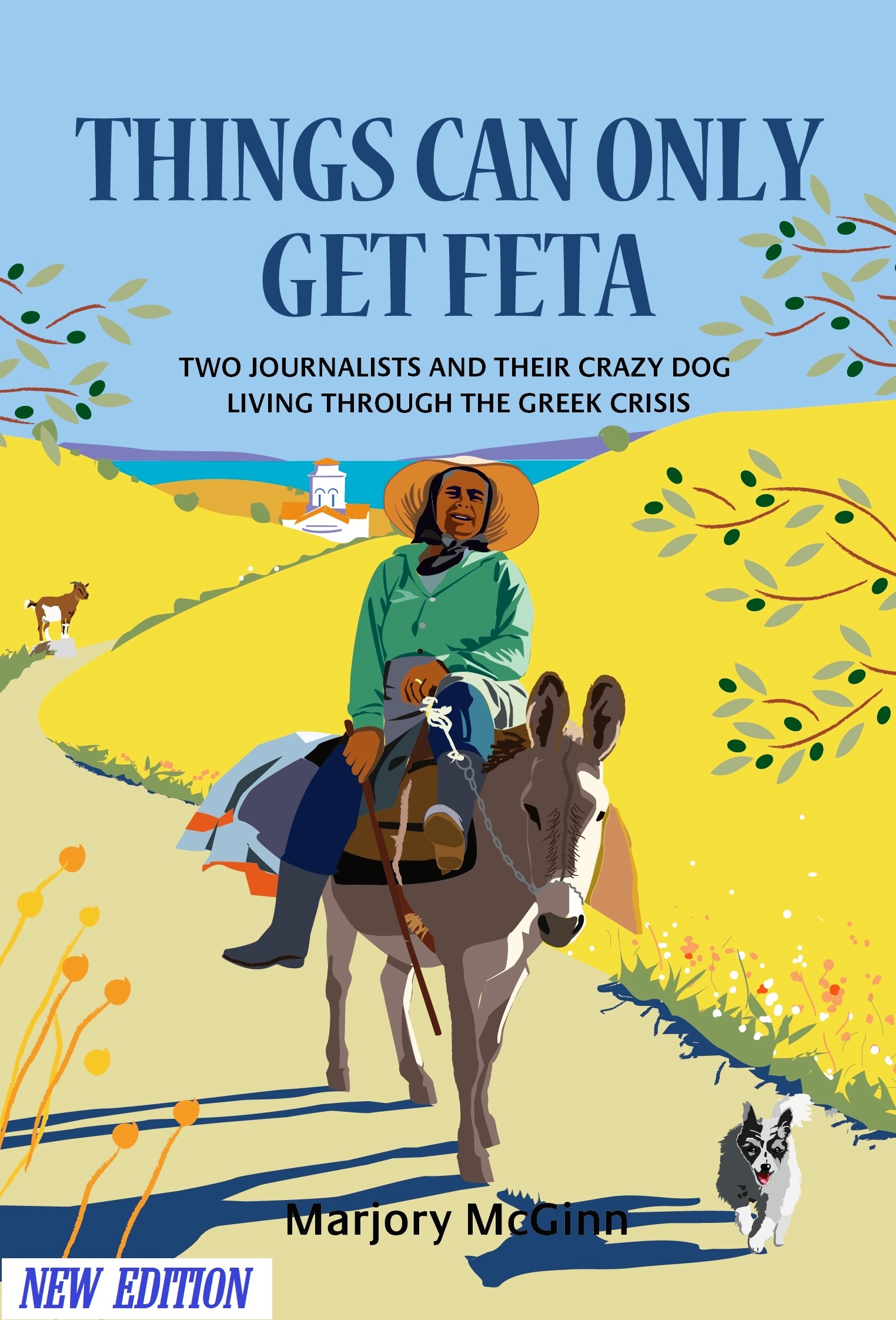
fetanucover_booksize-01 - Copy (2)Book news – Things Can Only Get Feta

AFTER being out of print for several months, the paperback edition of Things Can Only Get Feta: Two journalists and their crazy dog living through the Greek crisis has been republished and is now available on Amazon sites:

 Amazon UK

Amazon US

It is also available on Kindle as well.

The book explores our first year of living in the Mani, in southern Greece, with our dog Wallace, trying to live as authentic a life as possible with sad and funny consequences. The sequel to this book, covering our last two years in the Mani, will be available in the summer.

For more information on Things Can Only Get Feta, visit the book page on this site www.bigfatgreekodyssey.com

Thanks for stopping by.

 Protected by Copyscape Web Copyright Protection

© All rights reserved. Text and photographs copyright of the authors 2015. No content/text or photographs may be copied from the blog without the prior written permission of the authors. This applies to all posts on the blog.


Facebooktwitterredditpinterestlinkedinmail
Please share this post

What’s Greece in winter really like?


boats caption here pleaase

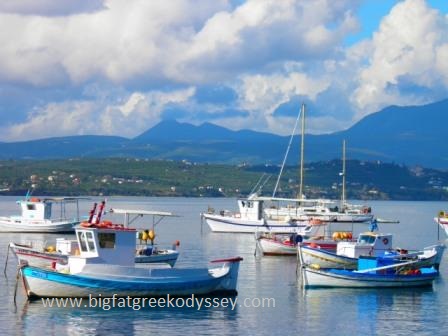
Fishing caiques in Koroni harbour at the start of winter

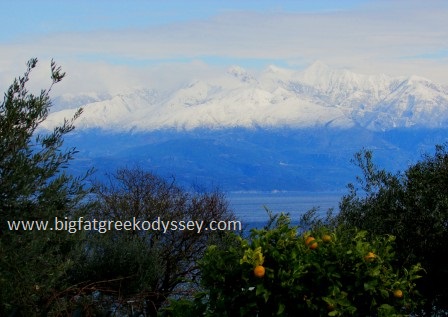
MY work desk is currently a blue metal kafeneion-style table parked in front of the balcony windows. The view from here is always glorious, across the olive orchards to the Messinian Gulf, but now it’s a winter scene. Dark clouds scud over the vast expanse of water. There are snowcaps on the Taygetos mountains opposite. In the olive groves some stoical harvesters have spread their nets and are working in the rain and cold. We were swimming just a few days ago – but there will be little chance of that now as winter deepens.

caption here for moody gulf

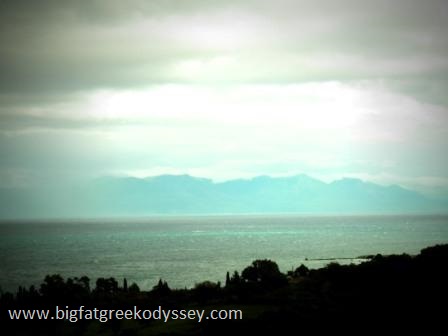
The view across the Messinian gulf towards the Taygetos mountains in the Mani peninsula

Everyone adores Greece in summer – the endless hot days, the warm clear sea, the tavernas brimming with happy holidaymakers – but what’s it really like living in Greece in the winter? Well, it’s very different, of course. And while it’s hard to imagine in the punishing heat of August, it does get pretty cold in winter, especially in January and February, when an icy wind blows down from the mountains, or here in Koroni (at the tip of the Messinian peninsula), across from the Ionian Sea.

Snow-capped peaks of the Taygetos mountains in December

It can rain for days on end, powerful, heavy rain. A few weeks ago we had something like a mini-hurricane in Koroni, with heavy winds and hailstones. There were mudslides on the hillside where we live and stone walls collapsed along the narrow road between the olive groves. On the Mani peninsula, opposite, there was a twister one day and then a storm that caused havoc to the small villages along the coast. But by the spring, the damage will be sorted, the beachside terraces renewed and tourists will never know we even had a winter.


lazy fat wally caption here for the old pupster

Wallace our cheeky Jack Russell keeping himself warm during the winter

Some days in December there were flashes of hot weather, with the temperature around 18 to 20 degrees C, and we’ve been seized by the crazy desire to grab our swimming gear and pile down to the beach for a bracing swim. We’ve usually been the only ones there but the experience has been worth it, even swimming with the snow- capped Taygetos mountains mocking us from across the gulf.

Now it seems property winter with cooler temperatures and days of rain and even Wallace our Jack Russell has been reluctant to get out of his bed in the morning. But there are compensations too: no summer pests … mosquitoes, hornets, snakes or scorpions now, apart from the huge beige one we found one morning sitting by the front door. It put us all into a tailspin, especially Wallace, who, true to his crazy breed, wanted to bark the critter into a swift retreat, as if it were a pesky Jehovah’s Witness with a pitch fork. He gave up eventually and scarpered – Wallace that is, not the scorpion, which Jim despatched with a sweepy brush.

Koroni is a popular harbour town. In summer, the narrow streets by the harbour are thronging with holidaymakers, the waterside tavernas buzzing with life. Now the road along the paralia is almost deserted. The outside terraces have their scuffed plastic sides rolled up, the tables and chairs have gone and cars park in the spaces now – at least when it isn’t stormy and huge waves roll across the road. It’s hard to remember now what it was all like in summer. For some people, this side of Greece is much less appealing, but if you love Greece, as we do, you won’t ever be bored.

In a working town like Koroni, there are always Greeks about and they have more time to talk now. There are only one or two tavernas still open, a few old-fashioned ouzeries and several cafes, as well as regular shops. When the sun’s out, the harbour still bustles but it’s different. The locals have reclaimed their town and the atmosphere is most definitely Greek. It’s now about everyday life and having a gossip over a Greek coffee and for many of the taverna owners who have survived their seven-day working week, all summer, it’s a blessed relief to have a normal life again. But with most of our favourite haunts now shut, we’re already missing the tables set by the waterside, the plates of sizzling kalamari, slabs of moussaka and the familiar bowls of Greek salad with a doorstopper wedge of Feta on top.

olive harvest picture here

The olive harvest is a familiar and comforting scene all over the southern Peloponnese, famed for its oil

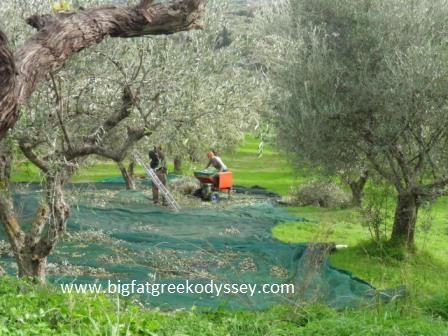
In this part of Greece, for now, all life revolves around the olive harvest, particularly with the bumper crop this year and with the higher price of oil. It has lifted morale in rural areas and brought hope where there has been little for the past five years. The roads outside the town are full of trucks stacked high with bulging sacks of olives, heading to the local presses. If you want to see how Greeks really live, winter’s the best time to be here.

caption for lonely chairs here

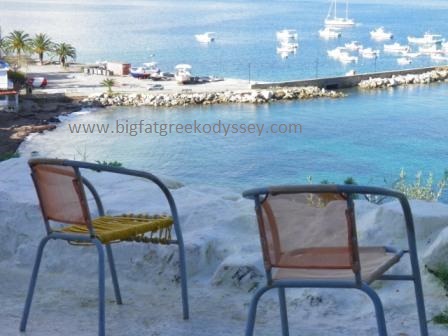
There’s plenty of winter seating for the strip of road outside the castle with its gulf view. But you might need to form an orderly queue in summer

If you look hard enough there’s still plenty to do. Even if you’re not particularly religious you can also take part in one of the many Orthodox services at this time of year, just out of sheer curiosity for its history and Byzantine ritual. A few days before Christmas we went to an intriguing service called the Iero Evhelaio, in Koroni’s main church of Ayios Dimitrios. It involved a blessing with holy oil. It was a small congregation and a long service, for which we were all given lighted candles to hold, which seemed to mark the duration of this service because by the time the candles had burnt down to waxy stubs in our fingers, it was close to the end.

It was a rather solemn service, apart from the moment when one of the chanters collapsed in a chair in a coughing fit with a case of incense overdose. Yet it felt rather Christmassy at the end when we all lined up in front of a small table, a bowl of warmed oil in the centre, and the Papas blessed each of us in turn, marking our faces and hands with small oily crosses. With good wishes from friends and neighbours, we left and wandered out into the cold night.

caption for ouzerie here please

One of the old-style ouzeries in Koroni

Some nights it’s pleasant just to go into Koroni and sit in one of the zaharoplasteia (pastry shops) and share a slab of rich, custardy galaktoboureko, for which this town is apparently famous. One Saturday night we discovered a small ouzerie by the harbour, where we had a simple meal of souvlaki, Greek salad and local wine. It’s an old building, with rickety chairs and tables, where mementoes on the walls remind you of an older, probably happier era in Greece.

The tables slowly filled up with locals, mostly drinking ouzo. One man called Andreas told us that in the past there would probably have been a few bouzouki players here and a singer or two for an impromptu night of music, but this is rarer now. But the next best thing for many Greeks on a Saturday night is the live TV music show called Cheers, Friends (Stin Iyeia Mas). Watching it is almost mandatory and in the ouzerie, a TV propped up on one wall was tuned into the show with its popular songs and vivacious bouzouki riffs, obviously delighting this assembled audience. Had we stayed to the very end I felt sure someone would eventually have got up and danced unselfconsciously around the tables. As we left, Andreas told us he played the bouzouki and he’d bring it there one night for a music session. What night, we asked? He shrugged. “When the mood takes me.” Okay, this is Greece. No rules. Take it or leave it!

caption for jim and his juicy pair here pls

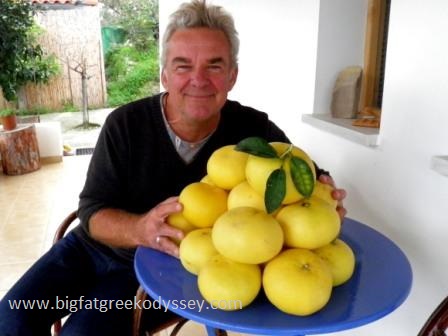
Jim is jealously guarding his crop of grapefruits, a mere fraction of what we have gathered already this winter

Winter in Greece is what you want to make it. If you don’t live here permanently, and we don’t, then you want every day to count, whatever the season. When the weather is fine we go out and explore the countryside or fuss over our new vegetable plot, with its crop of cabbages and broccoli and pick sweet winter oranges and grapefruits from the abundance of fruit trees we have around the house.

With fewer distractions in autumn and winter we have been lucky to have time to spend on projects. I have had plenty of time for writing and have finished a second book on our adventures in Greece, a task eased by an inspiring view and peaceful surroundings.

My partner Jim has been working hard on his new ebook editing and formatting business (www.ebooklover.co.uk) and twice a week he is attending government-run Greek classes in Koroni, aimed at beginners, and held in a local primary school. He’s finding it challenging since, as Greek is a hard language, but the class has not been without humour.

One night the charming teacher Panayiotis was explaining the possessive case with the sentence “to panteloni mas”, (our trousers) but one of the more advanced students was quick to correct him. “Surely it should be ta pantelonia (trousers, plural) rather than one pair?” which is what the teacher had written on the board, illustrating the fact that even Greeks can slip up sometimes.

Panayiotis covered his mistake quickly by saying: “No, this is Greece in crisis. We all have to share one pair of trousers now.” The class erupted in laughter, and even Panayiotis joined in. I doubt that anyone there will ever forget the plural for trousers at least, or the word for crisis, a Greek word after all.


caption for marjie on the beach

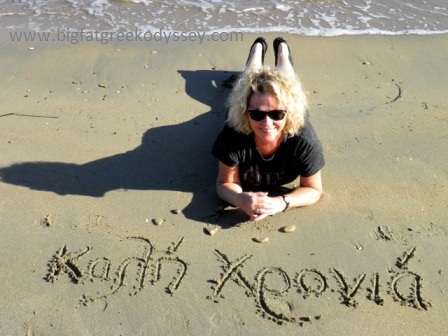
Marjory wishes you all Happy New Year after her last blissful swim of the year 


Happy New Year, Kali Xronia

WE’VE had a wonderful 2014, with quite a lot of it spent in southern Greece. It hasn’t all gone to plan because, in crisis-ridden Greece, things never do. We have had our adventures, frustrations and our moments of anxiety. But every day has been blessed with new experiences and we hope that next year will be as good. Wishing all our loyal blog readers a very happy New Year and a joyous 2015. I hope many of you will spend some of your holidays at least in Greece – even in winter!

Things Can Only Get Feta

For details about my book, recounting our adventures in the Mani, and for reviews and articles, please visit our Big Fat Greek Odyssey website, book page

Visit Amazon to buy the book (Kindle version – new edition). A new edition of the paperback will also be available shortly.

If you like the book please think about leaving a review on Amazon. It will be very much appreciated.

Thanks for stopping by.

 Protected by Copyscape Web Copyright Protection

© All rights reserved. Text and photographs copyright of the authors 2016. No content/text or photographs may be copied from the blog without the prior written permission of the authors. This applies to all posts on the blog.


Facebooktwitterredditpinterestlinkedinmail
Please share this post

How does Wallace handle 15 minutes of fame? Madly, of course …

Wallace surfing caption here

Wallace’s surfing antics always draw an audience. 

IT was supposed to be a relaxing few hours at a long sandy beach near Koroni, in the Messinian peninsula.  It was around 32 degrees and steaming.

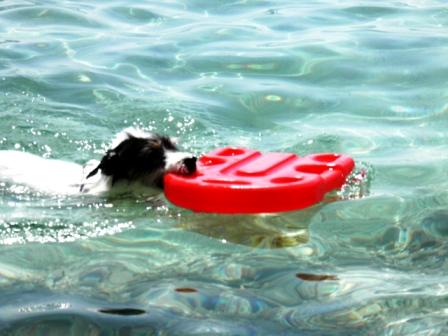
We picked the quiet end of the beach and couldn’t wait to jump in the water. Wallace wasn’t interested in trying out hang-five manoeuvres on his small red surfboard today but more intent on grabbing the board by its side handle and trying to swim to shore with it.

While we were engaged in a game of tug-of-war with Wallace and the board, two guys strolled along the sand and stared at our watery antics. They looked Greek and I assumed they’d probably never seen a Jack Russell terrier before.

Then one of them shouted in a London accent: “Hey, didn’t you write that book? Isn’t that Wallace?”

“You mean the Feta book?” I shouted back. Okay, I had to be sure.

They nodded. “We recognised Wallace straight away.”

Is Wallace so recognisably crazy, I thought? Obviously, yes! It gave us a good laugh anyway.

“We loved the book, by the way.” That bit was good at least.

The two boys were from the UK, staying at a nearby holiday villa, and had read the book a few months earlier.

“He’s so cute!” said the other guy. “We’ve got a Jack Russell as well.”

“Is he mad like Wallace?” I asked.

“He’s… em, quieter than Wallace.” Very diplomatic!

With impeccable timing Wallace decided to demonstrate crazy for a bit and ran up and down the shoreline with the surfboard clamped in his teeth. Kids were giggling and sunbathers running for cover. It’s exhausting for everyone really which is why we don’t take him to the beach very often. Wallace has always loved the beach and is a tireless swimmer. I suspect he also likes the attention.

Wallace out of sea caption

A Jack Russell terrier like Wallace is equally eccentric in the sea and on dry land

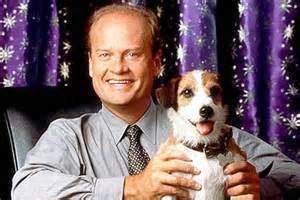
I think he always has. It’s in his genes! His Edinburgh breeder, Anne, told us recently that Wallace is related to Moose, the first Jack Russell to play Eddie in the US sitcom Frasier, after an American bought one of her dogs and took it over the pond. I used to watch Frasier regularly and fell in love with the dog. That’s why I always wanted one. What was I thinking?

Eddie dog in Frasier caption

Eddie the JRT terrier in Frasier 

“He’s just like he is in the book, isn’t he?” said one of the lads, chortling.

“Oh yes,” I sighed. “You bet.”

It’s always heartwarming to meet readers of Things Can Only Get Feta wherever they crop up and one of the great joys of being a writer. Wallace in particular has won quite a few hearts due to his appearance in the book. We recently met a lovely couple from Surrey who have a Jack Russell of their own and while on holiday in the southern Peloponnese, drove all the way from Kalamata to Koroni (over an hour’s drive) just to see Wallace. Overshadowed by a Jack Russell? It’s okay, I’ll get over it!!

The easy charm of Koroni


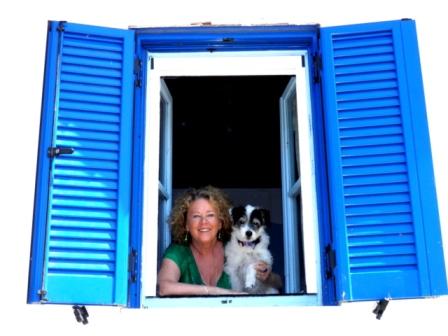
Wallace and Marjory at window caption

Wallace and Marjory looking at the world from a Greek window


We are currently based just outside Koroni in a small Greek house for the summer. It’s around 200 years old, with an archetypical style: white with blue shutters and shady balconies everywhere. It’s in a lovely location in an olive grove with distant views of the sea. In the garden we are growing tomatoes, peppers and aubergines. There are also clumps of oregano, mint and marathos, fennel growing nearby.

When the owner comes to strim the grounds, the air is full of fresh herby aromas. There are fig, lemon, orange, apricot and almond trees as well and several grapevines already drooping with fruit.

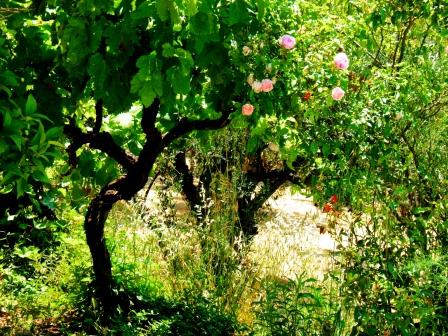
Garden at Koroni caption

Grapevines and roses in our Koroni garden

There are old rose bushes growing as well, planted by the owner’s grandmother, and it’s not hard to imagine how pleasant it would have once been here with the whole family gathered on the balcony enjoying one of the many light breezes that sweep up from the sea most afternoons and cool the tip of this peninsula.

As with most of rural Greece, there have been critters as well. Jim has already found two large scorpions in the garden and pulverised them, I’m afraid, with a breeze block. We also saw a snake slither under a metal baking tray beside the old fournos (woodfired oven) in the garden, while we were tidying up. Not sure what kind of snake it was (a deadly ochia, horn-nosed viper perhaps?) we made a hasty few calls to the owner who came along her brother, who was equipped with a long bamboo pole (snake sorting implement). He threw back the tray to reveal … well, a rather tiny snake, and not worthy of all the fuss we made about it. The family were very gracious about calling them out and we even got a short snake handling/despatching lesson, which I hope we’ll never need.

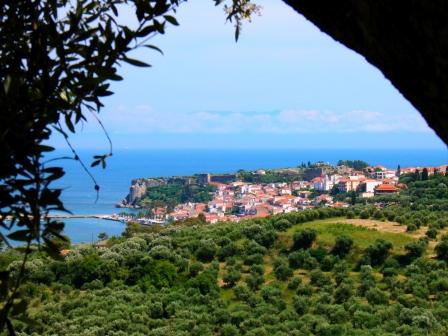
Koroni town caption

A view of Koroni town with its old castle and harbour through the olive groves

Koroni has proved to be a very friendly and laid-back town. This lower part of the peninsula (left hand one of the three southern prongs), facing the Ionian sea on one side and the Gulf of Messinia on the other, feels more like a Greek island at times rather than the mainland. It has a casual charm about it: a row of tavernas along the waterfront, as well as bars and cafes, while tucked away in the narrow backstreets that ascend to the old castle are traditional kafeneia, ouzeries, bread shops, general stores, and some nice churches as well. In my next blog I will feature some of our favourite places in Koroni.

Wally in pink caption

Wallace showing a more demure side to his personality 

Wallakos 

Wallace has been given a new name while we’ve been in Koroni. In the Mani, where we stayed for three years, he was called Vassie. But one of our lovely friends here, Stavroula, who is fond of dogs, decided to call him Wallakos, ‘little Wallace’, which is cute and we have started using it as well. But sometimes Big Wally seems more appropriate!

GREEK BOOK IN NORTH AMERICA

My book about living in the Mani, Things Can Only Get Feta (Bene Factum Publishing), is available in North America, paperback and Kindle. It’s available on Amazon.com and through Barnes & Noble and Longitude Books. Longitude kindly featured it last month in its June Newsletter and on its blog page called A Favourite Spot. If you read the book and like it, please think about putting a small review on Amazon. It will be much appreciated. Thanks to all the North American readers for your support.

For details about the book and other places to buy it and for reviews and articles, please visit our Big Fat Greek Odyssey website, book page

Visit Amazon to buy the book (Kindle version – new edition). A new edition of the paperback will also be available shortly.

Thanks for stopping by and your comments on the blog are always appreciated.
 Protected by Copyscape Web Copyright Protection

© All rights reserved. Text and photographs copyright of the authors 2014. No content/text or photographs may be copied from the blog without the prior written permission of the authors. This applies to all posts on the blog.

Facebooktwitterredditpinterestlinkedinmail
Please share this post

They live in North America but Greece is still home …

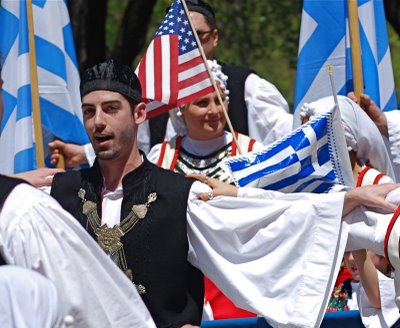
greekparadeinus

A Greek-American parade in Chicago

WE had an experience recently in Koroni that brought home to me the enduring, sometimes fateful connections between American and Canadian Greeks and their homeland.

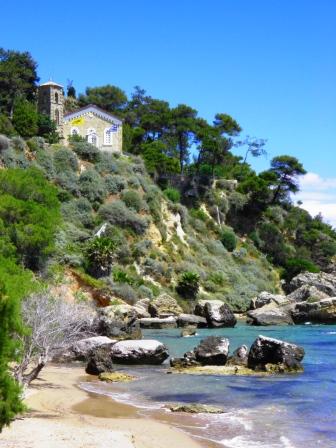
Not long after we arrived back in Greece this year, this time at the tip of the Messinian peninsula in the southern Peloponnese, we started visiting a small, secluded beach on the other side of Koroni, facing the Ionian Sea. At the back of sandy Zaga beach is a set of stone steps and we were intrigued enough to climb them and discover what lay beyond – a white house with a large shady garden.

OLYMPUS DIGITAL CAMERA

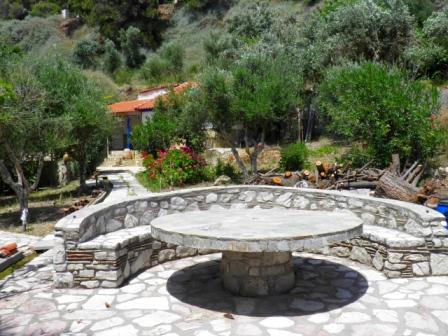
A stone table built for Big Fat Greek lunches

Its best feature by far was the huge round table made of stone on a thick plinth and a curved stone bench around one side that could easily fit a dozen or more people. The place gave the sense of Greek ownership and I could imagine a big, garrulous family sitting here on hot summer days sharing a meal. Perhaps it was owned by Athenians who only came in the high summer.

Every time we went to the beach we pondered who the owners were. But in a quirk of fate, I was to find out sooner than I could ever have imagined.

After my book Things Can Only Get Feta was published in North America on May 1, I had a few emails to the website from readers, and one in particular from a lovely woman called Alexia from Montreal, Canada. She had a particular interest in the book as her family originally came from Kalamata, and the rural Mani. We exchanged several emails and she told me she had spent a few summers back in the southern Peloponnese visiting relatives and friends.

Since I mentioned living in Koroni, she sent me a photo of her father on a beach here – and I recognised it straightaway. Zaga, the beach with the stone steps. I quizzed her about the house and, sure enough, it was owned by a Canadian friend of her father. Small world. She had been to the house in the past and had had one of those long summer lunches, just as I had imagined.

OLYMPUS DIGITAL CAMERA

Zaga beach, Koroni, beneath the church of the Panayia Eleistria

It was certainly a spooky coincidence, you might think, but not where Greece is concerned. The longer I stay in this country, the more I recognise the tight webbing between Greece and the Greek diaspora (fittingly a Greek word) of Canada and America, and Australia too; the families who had to leave, mostly for economic reasons, though sometimes political, sometimes in a desperate bid for freedom, who have never forgotten their faith, their culture and whose connections between the two places continue to spread and flourish.

In the past year I have had many North Americans becoming regular correspondents and FB & Twitter friends, especially among those whose families came originally from the southern Peloponnese. I am always impressed and touched by their passion for Greece, how the more recent emigrants from the past four decades talk about the place as if they’d never left it, sharing pictures on FB, reminiscences and anecdotes. Many talk longingly of their next visits in the summer, counting off the days, even though most have successful, happy lives in North America. But to these people, Greece is still their patrida, their homeland.

OLYMPUS DIGITAL CAMERA

Many Greeks fled to North America from Kalamata after the city’s devastating earthquake of 1986

As Alexia explained: “My Dad has shared so many stories of his childhood and of his teenage years (in Greece). His father, who passed away the year I was born, shared stories of the war he lived through. He planted the trees at the Anastasi (church) on Navarinou Street in Kalamata. My uncle Soulis dove for the cross in the water for the Epiphany holiday (in January) when he was a teenager. Crazy to feel so connected to a place that my brother, sister and I have only visited a handful of times.”

It makes me think a lot of my own family and how closely it parallels emigration from Scotland, and the Scottish diaspora. After historic skirmishes with the English and from the time of the infamous Highland Clearances of the 18th and 19 centuries when tenant farmers were evicted from their land, Scots have been leaving the country in droves seeking political and economic refuge mainly in North America, Australia and New Zealand.

More recent departees, like my family, left to seek new opportunities in Australia in the 1960s, lured by assisted migration, the famous £10 boat ticket to freedom. Despite decades in Australia my family always called Scotland ‘home’. “We’re going home next year for a holiday,” they would tell their friends, as if the permanent lives they had so painstakingly etched out in Australia were nothing but a temporary fix. Which they weren’t.

OLYMPUS DIGITAL CAMERA

Gorgeous Kapsali beach on the island of Kythera. The island has been dubbed “Little Australia” because of the number of villagers who migrated there and then returned

Greeks are everywhere in the world, in every far-flung corner, and so are the Scots. Two very different diaspora – Greeks and Scots, but we both do exile very well.

But what the Scots don’t do is keep up the cultural life of their homeland the way the Greeks do. Perhaps if we had the vast extended families that Greeks have, we would. We tend to float away into our individual lives and endeavours and in a few generations our Scottishness is often diluted. Not so the Greeks.

I have followed my North American friends’ posts on FB and Twitter with admiration and often envy: how they have built Greek Orthodox churches to rival many in Greece and sent their kids to Greek language school, kept up the rituals of Easter, the saints days, name days, and all the Big Fat Greek weddings. Greekness is alive and well in North America. A massive achievement. How could it be otherwise?

OLYMPUS DIGITAL CAMERA

The bay of Otylo in the remote Mani region which has seen mass migration to the New World

Yet for all that, they often talk of an intense longing for what they or their family have left back in Greece and the things that can never be replaced. Some of this sentiment was conveyed beautifully by Katie Aliferis, a Greek American from San Francisco, in some of the poetry she shared earlier in the year on my blog. Her poems express an intense love and longing for the remote Mani region in the southern Peloponnese, and for her village of Areopolis and the old family home,  even though Katie has, remarkably, never set foot in the country.

Most Greeks would probably never have chosen to leave their homeland and you understand this better when you see some of the outstanding places they hail from, physically beautiful with a traditional, often rural, way of life that can’t be replicated anywhere else, and villages that are now semi-abandoned, ironically due partly to the mass migration.

While living in the Mani we came across a semi-deserted hillside village that was hosting a big Greek wedding for a family from Chicago. It was, unusually, filled with noise, music, life, and for a few days, the small Greek population was vastly outnumbered. Some of the Greek villagers remarked that it all felt like old times.

Wars and occupation have driven out the Greeks, so did the military junta of the 60s and 70s. But also earthquakes, like the devastating Kalamata earthquake of 1986, and the recent economic crisis has tragically forced Greeks to leave yet again, seeking opportunities elsewhere. These circumstances will no doubt inspire a painful longing to return one day and to never forget where ‘home’ really is, despite making wonderful lives in their new host countries. Whenever I hear an American accent now in the Peloponnese I am more attuned to the complex stories behind the sunny repartee.

My new Canadian friend Alexia says she will be back this summer, as will some of her family. They will visit their ancestral homes and also Koroni. A lunch around the stone table at the house by the sea will probably be on the cards. In my mind I can already see them crammed around it, full of kefi (high spirits) sharing a typical Greek meal, under shady trees, the sea a few stone steps away. The circle will then be complete.

GREEK BOOKS

My two travel memoirs about living in southern Greece, Things Can Only Get Feta, and the sequel Homer’s Where the Heart Is are available in Kindle and in paperback through all Amazon sites

www.amazon.co.uk or www.amazon.com

For more information about the books and other outlets please visit the book page on my website www.bigfatgreekodyssey.com 

Thanks for stopping by and your comments on the blog are always appreciated.
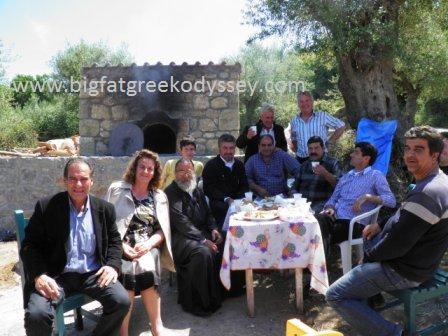
 Protected by Copyscape Web Copyright Protection

© Text and photographs copyright of the authors 2016. No content/text or photographs may be copied from the blog without the prior written permission of the authors. This applies to all posts on the blog.

Facebooktwitterredditpinterestlinkedinmail
Please share this post

Back in Greece & barking mad to travel with a Jack Russell!

koroniandcastle

The coastal town of Koroni nestling under the mighty walls of its 12th century castle

WELL that’s us back in Greece for another adventure, but more of an Odyssey-Lite compared with last time. We went by car again so we could accommodate the great travel mutt Wallace and, as before, it created scenes of joy and angst. The joy was seeing how well he behaved in a car packed to the gunwales and how he slept the whole way and only barked at motorway toll collectors. We are in accord on this one.

Caption here for Wallace in Switzerland

Wallace the Jack Russell scaling the peaks of travel in Switzerland

The angst came in the form of a check-in at an Italian hotel (part of a big chain) that claimed to “take dogs, of course!” We got told off in the foyer by the manager when Wallace did a round of screamy barking at two teenagers who were shouting and skittering about, making Wallace nervous. They were making me nervous as well. One thing I’ve discovered about Wallace over the years is that he’s really quite conventional for a fizzy Jack Russell and, apart from people shouting and screaming, he doesn’t like folk wearing outlandish clothes: funny big hats, eye-watering colours, and so forth. I think most of all he barked because he didn’t like the hotel manager’s outfit: apple green trousers; loafers, no socks; a blueberry-coloured jacket. And I have to agree! What was this? Horticultural couture? But all went well really, most especially when we quit the establishment, our foreheads beading with sweat and Wallace muzzled up this time, and looking like a detained psychopath.

Caption here for Bellagio on Lake Como

The pretty town of Bellagio on Lake Como

On the trip, we had our first ever satnav and discovered that telling it to find the quickest route anywhere isn’t always a good idea. On our way to a hotel above the shores of Lake Como, the satnav arrow pointed straight across the lake at one stage. What? Did it think we had an amphibious vehicle?

“What’s it trying to tell us here,” said Jim plaintively as we followed the lakeside road, getting closer to the predicted lake plunge. All was revealed, however, when we came to a dead end at a small ferry terminal where it was explained by a grumpy ticket seller that this was the quickest way to the hotel, down the wrong side of the lake and across on the ferry to the town of Bellagio on the other side, where the hotel is situated. How were we to know? But if we’d been much later we’d have missed the last ferry. That wouldn’t have been quick!


Caption here for priest in church

The Pappas at the church of the Panayia Eleistria in Koroni handing out the ‘holy light’ on Easter Saturday 

Caption here for Jim in church

Jim guarding his flames after the spectacular climax of Greek Easter

Greek drama

Lovely to be back in Greece in spring, and at Easter. We managed three swims in the first week and almost an Easter service every night of Holy Week, and enjoyed the high drama of Great Saturday, outside the church as people held their candles with the “Holy Light” first brought out by the Pappas at midnight and shared to the congregation from there. Bells tolled and fireworks boomed on the periphery and everyone went home, well resurrected, but with their ears ringing.

Koroni has a nice feel, with its harbour and narrow streets winding up to the castle on the top, which was once a stronghold of the Venetians. It’s easy to see why various imperial groups wanted to control it because the castle was almost impregnable and the town out of sight from the sea, cuddled by a high, wooded headland.

Caption here of Koroni Castle

The town reaches up to the castle walls which encloses a monastery at the top with superb views on all sides

Caption here for Koroni Castle chapel

A tiny chapel at the monastery of Timios Prodromos with stunning views down to Zaga beach

The castle has been razed now apart from its massive walls but inside is the delightful leafy monastery of the Timios Prodromos, which has only six nuns left. It’s a peaceful, dreamy spot, and the small shop near the entrance has a phenomenal range of items hand-made by these industrious nuns.

It’s one of those monasteries that posts a list of what you can’t do, or wear, inside the monastery church. No trousers for women, which ruled out a church visit for me, though there is still plenty to see here with a fragrant garden with fruit trees and flowers. There are various nooks here to wonder around and touches of drama amid the foliage. A tiny courtyard had a stone entrance with a carved lintel saying: Orthdoxia i Thanatos Orthodoxy or Death. There is also the tiny Byzantine church of Ayia Sophia built beside the ruins of an ancient temple dedicated to Apollo. Some of the original remnants of this temple have made their way into the later walls of the castle.

Caption here for Koroni wall at monastry

Remnants of Apollo’s temple at the Prodromos monastery have been cleverly inserted into the later castle walls

Jim was left at the monastery gates with Wallace because we assumed the nuns wouldn’t permit dogs, JRTs especially, but when I mentioned this to one of the nuns later she surprised me by gripping my arm and saying: “Bring him in, we don’t mind.” Ah bless! But take Wallace to a quiet monastery with six genteel nuns wearing unfamiliar headgear, long flappy skirts, and half a dozen aging Easter pilgrims outside the shop trying to enjoy their delicious loukoumi (Turkish delight) and glasses of chilled water? I think not! Maybe on a quieter day.

Caption here for Wallace at computer

Wallace comandeering my work station and chair on the balcony with its view towards Koroni 

The house we are staying in here has a wonderful view of Koroni and the sea. My current workplace, a table on the balcony for the laptop, is possibly the best I’ve had for a while but the only problem is keeping Wallace off my chair. He won’t hand it over until I confess what I’m writing about him next. Has he lost the plot? I’ll let you all know soon enough…

GREEK BOOK IN NORTH AMERICA

I AM thrilled to announce that my book about living in the Mani, called Things Can Only Get Feta (Bene-Factum Publishing), is now available in North America, paperback and Kindle. It’s available on Amazon.com and through Barnes & Noble and Longitude Books in America. Longitude has kindly run a story about the book on its blog page called A Favourite Spot.

The go-to blog for writing tips

I was recently interviewed by Athens-based writer Maria Messini on her fascinating  blog MM Jaye Writes, under the category Work In Progress. The blog is geared towards writers, their methods, tips, networking secrets and is a fabulous resource for all writers whether they have publishers or are making their own way in the self-publishing world. Read the interview here:

For details about my book Things Can Only Get Feta and other places to buy it please visit our Big Fat Greek Odyssey website, book page

Visit Amazon to buy the book (Kindle version – new edition). A new edition of the paperback will also be available shortly.

Thanks for stopping by.

 Protected by Copyscape Web Copyright Protection

© Text and photographs copyright of the authors 2014. No content/text or photographs may be copied from the blog without the prior written permission of the authors. This applies to all posts on the blog.
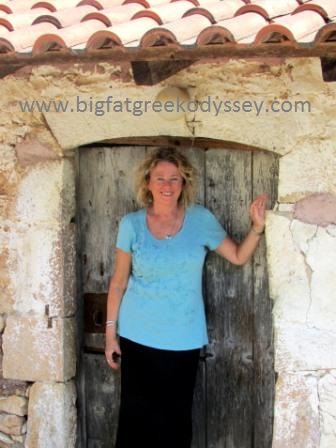
Related Posts Plugin for WordPress, Blogger...Facebooktwitterredditpinterestlinkedinmail
Please share this post