St Theodora – the woman who turned into a church, Arcadian sojourn …

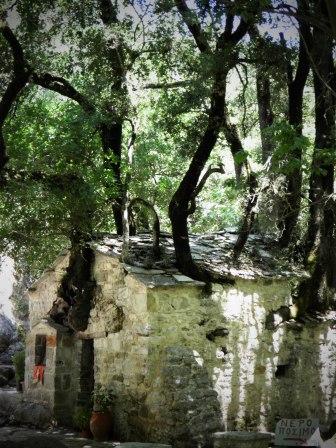
Branching out: The curious sight of oak trees growing from the roof of Ayia Theodora church

TREES grow in curious places and miracles abound where you least expect them – it would seem. On the roof of the tiny stone church of Ayia Theodora, oak trees began to grow after the building was constructed in the 10th century and they’re still there today, their roots apparently reaching down through the walls of the structure towards the natural spring below. Why and how? It’s not clear. Locals say that in line with the curious history of the church, it’s a miracle. Structural experts and academics have visited and studied the church and have so far been unable to offer a scientific explanation for the odd tree growth or its longevity.

It is certainly the strangest and most oddly appealing church we’ve encountered in the Peloponnese so far. And it was especially to see this ecclesiastical phenomenon that we drove to the village of Vastas in Arcadia (a two-hour drive away) on a day when the temperature was nudging 40 degrees. The sun was blistering and yet, in the clearing of a forest where the church is situated, the atmosphere seemed cool and energising, with the natural spring that runs under the church oozing fresh, sweet water into a nearby stream.

The tiny stone church squats under the weight of the 17 trees that soar up from the tiled roof like a stiff-brushed hairdo of eccentric proportions. The curious thing is there is little trace of tree roots apart from a large knot of ancient wood breaking through the stone wall above the front door of the church and disappearing again into its structure. In the confined space inside the church, with its several icons of Ayia Theodora, there is no sign of a root system, however. From the outside, and apart from the front oak, the trees simply appear to be growing straight up out of the tiled roof itself, as if floating on air.
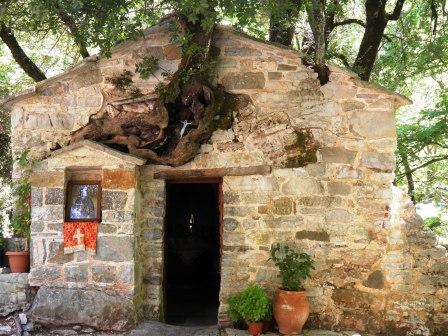
Knotty problem: The front of the church showing a section of tree root which has grown there for over 1,000 years

The local Greeks have believed throughout the centuries that this is a sacred place and that the structure is the miraculous form of Saint Theodora, who prayed before her untimely death for her body to be turned into a church, her hair to become a forest of trees above, her blood a river.

Saint Theodora’s is a curious story even for the Byzantine era in which it originated. In the 9th century, the pious Theodora wished to join a monastery, yet for reasons we’ll never understand decided against a women’s monastery and joined a male establishment instead. After disguising herself as a young man, she changed her name to the male equivalent – Theodoros – and there began her earthly trials at least.

While on one of her many travels outside the monastery to raise funds for its charitable work, a young nun from a nearby monastery, who was pregnant, claimed Theodoros was the father of the child in a bid to protect her real lover. Again for reasons that are blurred with time, Theodora kept her gender a secret and decided to take the rap for the incident as a mark of compassion for the nun’s plight, and the saint was tried and sentenced to death by decapitation.

As the story goes, when the executioner and his cohorts saw Theodora’s naked body before her burial and realised her innocence, they repented their act and built a church to honour her good deeds and her martyrdom.

It was while she was awaiting execution that she uttered her prayer with the wish to be literally turned into a church. A curious story, of course, and while the church itself may not be on a par with other sacred shrines around the globe, and while so far as we know there have been no recorded miraculous healings, the church attracts thousands of pilgrims from all over the world, who come here to keep vigil in the shaded forecourt of the church.
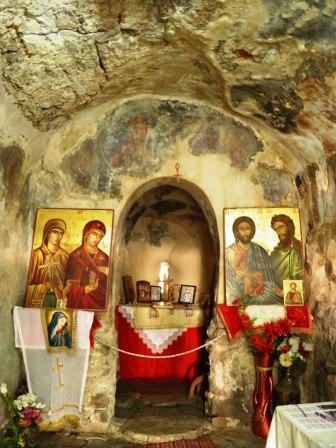
Inside a mystery: Not a tree root in sight within the walls of the tiny church in Arcadia

The church has attracted many engineering experts over the years from Greek and overseas universities. None have so far been able to explain how the walls have been able to withstand the growth of roots through them over a period of more than 1,000 years without the tiny structure of the church being destroyed.

One Greek engineer noted that the weight of the trees on the roof would be around nine tons, which is four times greater than what would normally be tolerated by a structure of this size. Added to this, during times of high winds and rain there would be an even bigger, more disastrous load on the building.

However this odd phenomenon has taken root it is worth seeing for yourself, if miracles excite you at all.  Certainly this part of Arcadia is a fascinating mix of stunning mountains and plains and is only marred by the power-generation plants outside the modern town of Megalopolis. It’s an important industry in this region, but the sight of two giant smoke stacks belching out pollution, at what is sometimes said to be Athenian levels, is slightly discouraging.  At least they’re not visible from every vantage point and there are plenty of stunning beauty spots here, like the archaeological site of Lykosoura.
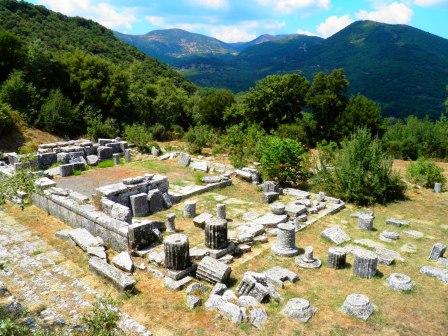
World’s oldest city: Part of the ruined Temple of Despoina in the ancient site of Lykosoura

Said to be the oldest city in the world, it has the intriguing, ruined Temple of Despoina (the Mistress) dating back to 180BC and situated on a peaceful hillside. The cult statue of the goddess Demeter was once situated here and this was the site of various ancient Mysteries we can only guess at now.

A short drive from here is Mt Lykaio, or Wolf Mountain, with staggering views of the southern Peloponnese on a clear day, and the Taygetos mountain range. It has a windswept Scottish highland feel about it, complete with bright coloured thistles growing on the hillsides and not a soul to be seen. There are tiny churches in the folds of hills, rusting signposts, and other ruined archaeological clusters with columns lying like bleached bones in long grass.
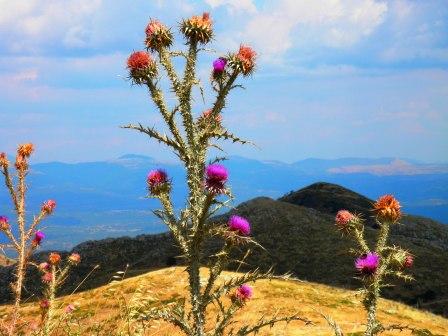
Greece or Scotland? Colourful thistles growing in the hillsides near Mt Lykaio in Arcadia

It was so swelteringly hot, however, that we had to forgo a walk up the final bit of dirt track that leads to the top of Mount Lykaio. Instead we drove back towards the plain and fell upon a natural spring water outlet by the roadside, where the water is cold, sweet and mythically refreshing. We refilled all our empty drink bottles, and later Wallace the dog jumped in to cool his heels. Or maybe he just thought that by immersing himself in the water from Wolf Mountain he’d turn into a tough-guy terrier.
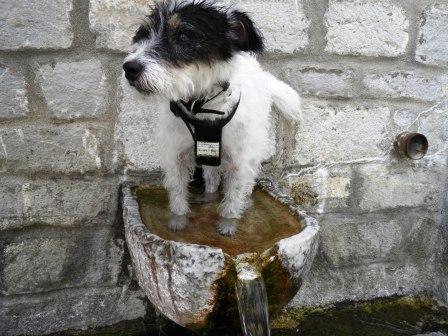
Paws for refreshment: Wallace the Jack Russell cools off in the spring water that flows from Mt Lykaio

Back in the Mani, the church of Ayia Theodora with its crazy Einstein hair seems a world away and yet it is a strange co-incidence that brings it into clear focus again.

One afternoon we are swimming in a quiet cove where several Greeks are floating about under their hats when we get into conversation with a man who is paddling by. He tells us he is in the Mani for his annual August vacation, and that he comes from no other place but the village of Vastas, not far from the church of Ayia Theodora. We ask him: Is the tree growth miraculous?

He smiles under his white baseball cap and tells us that lots of smart university types have looked at the church and measured it and pondered over it. “No-one can ever explain it,” he says with a big Mediterranean shrug.

“So it’s a miracle then?”

He points to the sky. “Only the man up there knows for sure.” He winks and paddles off.
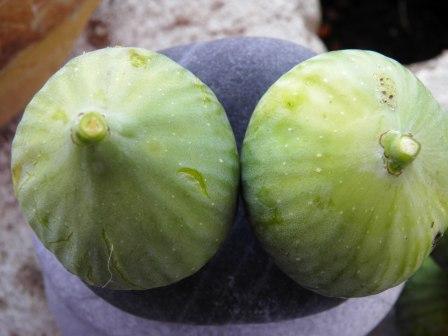
 

Double delight: Our first succulent figs of the season


First figs and sea songs

AUGUST has been sweltering. There’s hardly been a day when the temperature has been below 35 degrees, with not one drop of rain or a cloud in the sky. But August has brought the first figs and we have already raided nearby trees for our first supplies and stuffed ourselves silly with them, knowing that in a few short weeks they will all be gone. A lot like the Greek holidaymakers of August who swarm the Mani beaches and entertain us for hours with their manic beach capers and their sheer exuberance for summer, and for that first leap into a cool sea every morning.

Greeks are so completely at home by the sea, and uninhibited, that watching them at play there is a window into their eccentric souls. One morning in a cool sea as flat as a mirror I could hear a man, away out in the deep, singing at the top of his voice, for a good long while. He had a strong, melodic voice and was singing a variety of popular Greek songs, mixed with some opera. For want of something better to do, I swam out to him, and in the manner of most Greeks got straight to the point, asking him why he was singing in the sea.

“I sing in a choir in Athens,” he said, “and this is the best opportunity I get on holiday to practise at the top of my voice, on my own.” Time to leave then, but not before I had put in a request for a favourite Greek song and as I swam back to shore I could hear the first sweet bars of it drifting over the glassy sea. Where else but in Greece, eh?  www.bigfatgreekodyssey.com

Marjory has written three memoirs about her adventures in southern Greece in which she also features a story about Ayia Theodora. Her latest book is A Scorpion In The Lemon Tree, available on all Amazon sites:

amazon.uk

amazon.com

Her two earlier books are also on Amazon. The first, Things Can Only Get Feta is currently on a promo on the British site for 99p. Amazon links below:

Things Can Only Get Feta

Homer’s Where The Heart Is

Thanks for calling by. x

 Protected by Copyscape Web Copyright Protection

© All rights reserved. All text and photographs copyright of the authors 2016. No content/text or photographs may be copied from the blog without the prior written permission of the authors. This applies to all posts on the blog

Facebooktwitterredditpinterestlinkedinmail
Please share this post

Easy road to Athens, 10 hot-spots in the city …

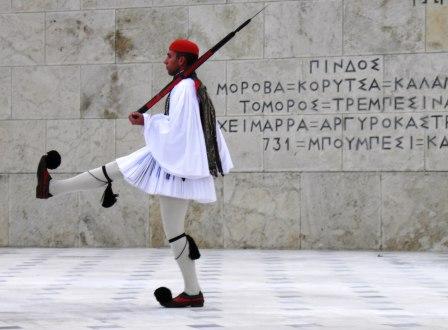
Best foot forward: An Evzone guard on parade outside the Parliament building in Athens

BEFORE we went on our recent trip to Athens, our first for many years, we were warned by other expats about how frenetic the city has become. We were told about bag snatchers around the tourist hot-spots, and their techniques were described in glorious detail by at least one expat. So we practised a few karate manoeuvres the night before, in readiness, and left with a tiny bit of trepidation.

We were also told by expats that we’d be bonkers to drive to Athens and that it was better to take the coach instead from Kalamata bus station. But having driven to Athens now, we strongly disagree with the doomsayers. The motorway from Kalamata was very smooth and pristine (especially the new section from Kalamata to Tripoli) and other drivers were mostly very restrained, which hasn’t always been our experience in the Mani. There was however the odd driver trying to break the land speed record while talking on a mobile.

The drive through the outskirts of Athens was a bit tormenting, but the Royal Olympic Hotel, where we stayed, offers a very detailed map on its website www.royalolympic.com for driving right to the hotel, and out again, which was brilliant. Once you hit the slightly down-at-heel outskirts of Athens, the sight of thousands of apartment blocks stretching to infinity is also a bit tormenting.

But the city centre  is great. It’s buzzy and clean. Okay, it is quite crowded and very modernised in parts. It’s not the wonderfully exotic Levantine hub it once was, but it has great appeal nevertheless.

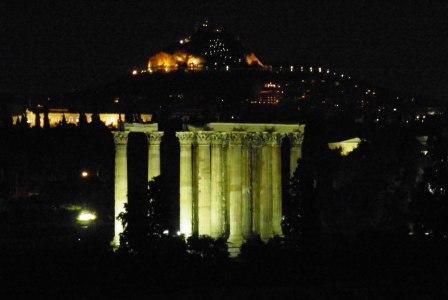
Majestic sight: The floodlit Temple of Zeus as seen from the rooftop garden at the Royal Olympic Hotel

As did our stay at the centrally located Royal Olympic Hotel, which offered us the upgrade of the Athenian Panorama suite with an eye-watering view across the road to the Temple of Olympian Zeus. Who wouldn’t want to fall asleep every night to the sight of 15 mighty floodlit columns?

We only had three days in the capital, which wasn’t enough, and a repeat visit is on the cards. It is possible, however, to see some of the main sights in that time, including the new Acropolis Museum, the Acropolis itself and the Benaki Museum. We also had time to take in the Ancient Agora, which is a huge, lovely site, if slightly neglected in parts, in the shadow of the Acropolis.

The Agora was once the social and political heart of ancient Athens, with temples, sanctuaries, libraries and meeting places. However, it was a men-only hangout and it was here that Socrates, Plato and Demosthenes came to argue the toss and thrash out the beginnings of our Western civilisation. Hard to see any reminder of that now among the fallen columns, ruined temples and broken walkways. Only when the wind rustles the long grass among the ruins do you get a whisper of the past.

But it was here that we identified the best public service job in the world – the Agora guards. They sit all day among the trees on plastic chairs, camouflaged as tired sightseers in their everyday clothing, guarding the antiquities and making sure there’s no hanky-panky in the undergrowth.

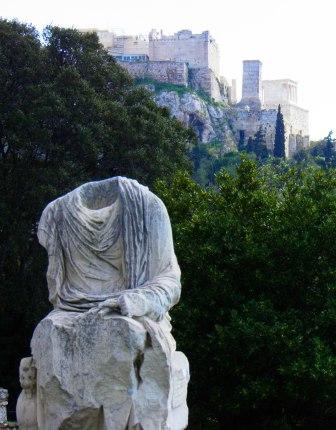
No head for heights: The statue at the Ancient Agora in Athens

One statue must give them particular grief. It’s a rather handsome but headless statue on a plinth of an Athenian thinker that must lure thousands of visitors for a look-here’s-my-head-on-a-Greek-statue photo opportunity, with the Acropolis looming in the distance for added creative appeal.

The day we were there we thought of doing exactly the same (well Jim did), but we were glad we didn’t try it. Some other wreckless soul was about to get his leg over the plinth when an Agora guard leapt out of her chair, sprinted over and admonished him loudly for the cultural barbarian he was and sent a few dozen tourists scattering for cover, including us.

Here’s our suggestions for other interesting sites, cafes, restaurants, and so forth, for anyone interested, and in no particular order:

1. The Benaki Museum on Vas. Sofias Avenue (www.benaki.gr) has one of the most eclectic and fabulous collections of Greek antiquities, icons, folk costumes, paintings. My favourite was the large collection of jewellery from antiquity to recent times. And the rooftop restaurant/café is very smart and seems to attract a bevy of well-heeled Athenian ladies and bon vivants. Not to be missed;

2. The old district of Monastiraki, with its flea market, tourist shops with tat we know and love, like those funny woollen slippers and cheesecloth shirts. And the old record/CD shops have great collections of out-of-date albums;

3. The Roof Garden restaurant on the top floor of the Royal Olympic Hotel is expensive but go up there just for a drink at the bar because the view, especially at night, of the Acropolis and the Temple of Zeus is stunning;

4. Visit the old fashioned grill taverna psistaria,  the Ambrosia, with good food, generous portions and authentic atmosphere on Drakou St, off Syngrou Avenue  (not far from the Acropolis Museum);

5. The Plaka. It isn’t what it used to be, Athenians told us. “The old neighbourhood is finished,” said one taverna owner. The ‘real’ people were moved on by the city’s bureaucrat planners to make way for the gentrification of the old Plaka houses, with their fabulous courtyards. I can’t comment on that but the area is still fascinating and full of tiny churches, small squares, and many fine restaurants. We ate at the Elaia in Erotokritou St, which is chic/traditional with good food and a nice atmosphere and a favourite apparently of film stars and other luminaries;

6. Melina’s café in Plaka, 22 Lissiou St, is worth a visit for its trendy bohemian chic and because it has the biggest collection of Melina Mercouri photos and memorabilia. Not because it was a favourite haunt of hers, the owner told us, but the collection was created to honour the life of this Greek icon. Zorbas Taverna, across the road, is also a nice venue (www.zorbasrestaurant-plaka.gr);

7. The Gazi area of Athens, near the ancient cemetery of Kerameikos, is also worth a visit. Gazi is a former industrial slum, now regenerated, with trendy bars, cafes, tavernas, but it’s a bit more edgy at night than the Plaka;

8. There seem to be very few city shops now selling folk arts – rugs, paintings, ceramics, jewellery etc, but the family-run Amorgos shop on Kordou St, Plaka, (www.amorgosart.gr) is a survivor, crammed with wonderful pieces. More museum than shop really;

9. The lovely 12th century church of Panayia Gorgoepikoos, which apparently means ‘Our Lady who Grants Requests Quickly’ is an oasis of calm in Mitropoleos Square, where you also find the Cathedral of Metropolis, which houses some of the sacred remains of Ayia Filothei, a saint who once help the city’s orphans;

10. The Korres shop, on Ivikou Street, Pangrati, for the full range of its natural toiletries and make-up.

Freedom or death 

OUR last day in Athens was the day before the March 25th Celebration of Independence. The War of Independence against 400 years of Turkish rule lasted from 1821 to 1829 and is still celebrated in great style in Greece, with marches and various state events, and one of its great catch cries is “Victory or death”.

On the 24th there was a students’ march planned and altogether the city was gearing up for the next day’s events, with a huge police presence in the city and army and navy units milling around in front of the Presidential building. Here the famous Evzone guards were wearing their ceremonial white skirts, pompom shoes and gold embroidered waistcoats and doing their precision slow-motion changing of the guard.

Desperate plight: Beggar in Syntagma Square with a sign saying “Please – I’m hungry”

There was a lot of bustle in the area and some took the opportunity to draw attention to various causes, personal or otherwise, like the woman in a headscarf sitting quietly in Syntagma Square begging, holding a simple piece of cardboard announcing in Greek that she was hungry.

If this had been Glasgow at 11am, she’d have been high on Buckfast tonic wine, sitting in a shop doorway, with probably a skinny mutt in tow, and loudly abusing passers-by. But at least the countless number of migrants who usually swarm Athens selling their fake Gucci bags and pirate CDs weren’t in evidence because of the number of police around.

Athens must have one of the highest concentrations of asylum seekers in Europe, as they come here via some of the islands off the coast of Turkey and then move on through Europe, often towards Britain, as we know. It’s one of the aggravations of this city, along with gypsy kids forced to beg at tables who will come back again and again and pester you until you give them something. It’s confronting, and sad, but it still seemed like a small problem compared to the fabulous cultural offerings that Athens has.

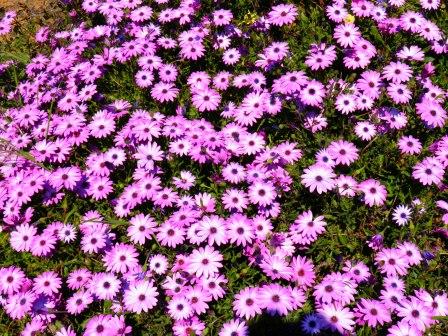
Purple haze: A riot of colour from spring flowers

Flower power: Wallace has spring on his mind

Spring delivers

THE turnaround between winter and spring is so much quicker in Greece than in Britain, of course. It’s lovely to see all the wintry thin trees and shrubs coming to life again. It’s hard to believe that the spindly branches of the mulberry trees that decorate our front garden will, in about six weeks, be thick and dripping with fat, red mulberries. The olive groves and hillsides are also carpeted in daisies, poppies, lilies and wild orchids. With the olive harvest complete there is still work going ahead clearing orchards of pruned branches, which are stripped and chopped for next winter’s firewood. In our village a priest with long beard and hair, blue cap and gown, regularly drives past on an orange tractor on the way to his farmlands to look after his other flocks.

Big Fat Athens Oddity

WE were pleased to see that in Athens motorbike riders wear helmets, as opposed to Kalamata, where mostly they don’t. Maybe it’s because of a higher police presence in the capital. But we were dismayed to see one helmeted rider who was fed up waiting for the red traffic lights to change on a major road. He mounted the pavement and roared along the busy footpath, weaving his way around startled pedestrians, before rejoining the road further along and speeding off.   www.bigfatgreekodyssey.com

© Copyright of the authors 2011

Facebooktwitterredditpinterestlinkedinmail
Please share this post

Losing our Elgin Marbles, the Acropolis rocks …

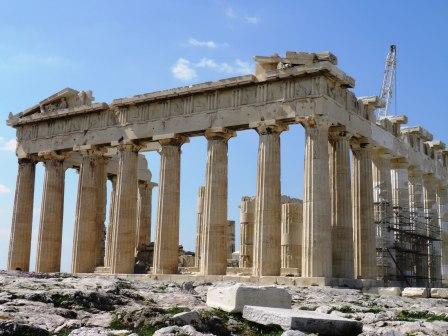
Simply marble-ous: The mighty Parthenon dominates the Acropolis in Athens

LAST week we sloped out of the Peloponnese for a trip to Athens, mainly to see the new Acropolis Museum for the first time. The museum, for anyone who hasn’t seen it yet, is outstandingly good, beautifully designed and the surrounding historic area of Makryannis, right beneath the Acropolis, is stylish too.

The design of the £110 million museum is inspirational, with glass floors in the main atrium area on each of the three floors and outside as well, where you can look down and see ongoing excavation work, which will take many years to complete, but one day visitors will be able to walk over ancient subterranean city streets.

This sense of completion, however, is not at all in evidence on the imposing third floor of the museum in the stunning Parthenon Gallery, where glass walls were created “to keep up visual contact with the monument” on the nearby Acropolis.

This is the gallery where the debate over whether or not the Elgin Marbles should be returned to Athens finally hits home. Until you see all the 5th century BC sculptures and frieze panels lined up, for the first time ever, together with copies of the missing items that make up the ‘marbles’ collection, and which are now in the British Museum, you don’t realise the full extent of the Elgin heist.

And even if you weren’t the slightest bit interested in the debate before, you can’t leave the museum without having an opinion, either way. If you were passionate to start with, I promise you’ll leave feeling very cross.

Nearly half of the original carved marble panels that make up the frieze running along the top of the cella (inner colonnade of the original Parthenon building) are now in the British Museum (BM) which amounts to 247ft of them out of the complete 524ft. The frieze is a fantastic portrayal of an Athenian procession and includes many dozens of horses and riders, and many of the best-preserved are the ones in the BM.

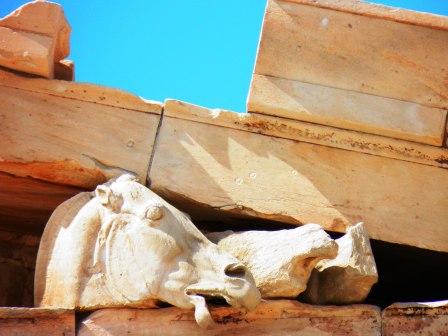
Sad sight: Copy of a horse’s head (left) on the east pediment of the Parthenon – the original is in the British Museum

Fifteen of the best-preserved carved marble metopes, that were placed high up on the external columns and depict mythical battles, are also in the BM. Seventeen of the best life-sized statues from the east and west pediments (gable ends) of the Parthenon, which are the most stunning feature of this building, depicting the birth of the goddess Athena on the east, and the contest of Poseidon and Athena for control of Athens in the west, are also in the BM. They include the gods and goddesses of Greek mythology – Helios, Dionysus, Artemis, Hestia, Aphrodite.

It is the pediments most of all that are a sad reminder of the Elgin “looting”, as the removal is called in the museum’s short promotional film, shown continuously on the third floor, or “plundering” as the museum’s guide book refers to it.

One of the arguments for the BM not returning the ‘marbles’ was that the British claimed Greece couldn’t be trusted to guard them for posterity and that Athens’  pollution problems had already eaten away at the Parthenon and the other Acropolis temples and sculptures. Yet the new museum, which has state-of-the-art laser technology for cleaning its marble artefacts (and techniques are on display in the museum), makes a nonsense of this argument.

The museum was built with the intention of one day housing all the treasures of the Acropolis, including the stolen Elgin pieces, yet with so many plaster copies on display, it just seems to be playing a waiting game, like a jilted bride hoping her faithless lover will leg it back, yet not quite believing he will. I hope Athens doesn’t have to wait forever for Britain to do the right thing. But will it?

Even the official opening of this museum in June 2009 failed to inspire a solution and ended in a strop between Greeks and the British over the return of the treasures and even saw the Queen and Gordon Brown, the then Prime Minister, withdraw from the event. Perhaps Brown, who hails from Fife in Scotland, the site of the Earl of Elgin’s ancestral home, was feeling a tad ashamed.

Lord of the Loot

Thomas Bruce (no relation to the Jim Bruce of this website, we’re happy to say) was the 7th Earl of Elgin when he took up the position of Ambassador to the Ottoman Court in Istanbul in 1799. He was given permission by the Athens government, then under the control of the Turks during the occupation of Greece, to remove a large hoard of statues and friezes, mainly from the Parthenon, that was dedicated to the goddess Athena in the 5th century BC, the Golden Age of Greek civilisation. Elgin intended to use this distinctive collection to adorn his aristocratic pile, Broomhall House in Fife, with Grecian splendour.

However, when he returned to Britain, Elgin was ill and broke and found his exploits on the Acropolis had whipped up rancour back home that even drew a passionate retort from the poet Byron who said the antiquities of Greece had been “defac’d by British hands”.

In the end, Elgin sold the ‘marbles’ to the BM in 1811 for £35,000, a handsome sum in those days, but half the amount he had asked for.

Elgin claimed he had acted in the interest of the Greeks by keeping these antiquities safe for posterity, but in fact Byron was right. While Elgin was looting the items from the Parthenon with his band of local workers, he damaged much of the remaining original works, and sometimes took only the upper part of statues, leaving the rest behind. Many pieces that were not good enough for the BM sale, as well as other items from the Acropolis, still adorn Broomhall House, where Elgin’s decendants still live.

It does all beg the question – what does Britain really gain by keeping the cultural assets of other countries, supposedly poorer than itself? It might have seemed clever  when Britain once had an Empire, now it just seems cheap.

www.theacropolismuseum.gr

To see a short film by Costas Gavras on the disasters that have befallen the Acropolis visit www.returnthemarbles.com

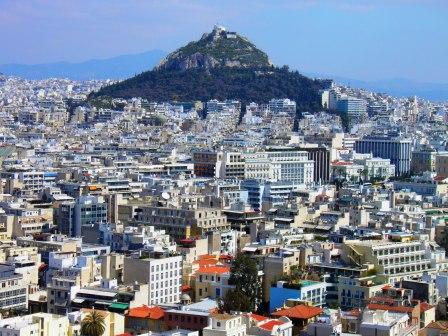
Sprawling city: The view stretching out across Athens from the Acropolis towards Lykavitos Hill

Love that rock

THE Acropolis itself, or the ‘holy rock’ as the Greeks still refer to it, is the most amazing place, with a view of the the city stretching out in every direction and even creeping up the lower slopes of the surrounding hills as well.

And despite ongoing restoration work to the Parthenon and cranes in evidence, workmen in hard hats, stone chisellers, crowds of tourists and stray, wolf-like dogs roaming the rock, the Parthenon still has incredible pull, even denuded of its sculptures, basically because the original design was a piece of perfection. Built to honour the Goddess Athena, this Doric temple has been hammered by more than the aristocratic follies of Lord Elgin, including earthquakes, sieges and explosions.

Tourists have probably been its worst enemy at times, and the Greeks have suddenly become quite paranoid about any desecration of its columns, and the whole environment of the Acropolis. There are many signs about the place telling you what you can and can’t do, which is quite prohibitive, including smoking, and making videos.

The sight of one young guy languishing on a bench of marble for a cute photo opportunity brought one well-built attendant with big Medusa hair flying out of her security cabin, waving her arms and admonishing the poor soul in front of a swarm of visitors. He’ll never do that again.

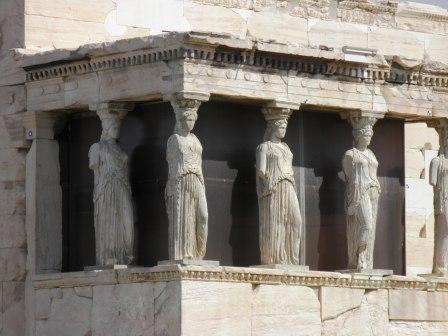
Movers and shakers: The Caryatids adorn one side of the Erechtheion on the Acropolis

It’s easy to see why the Greeks still love this place so much. It has become an enduring symbol of the Greek ability to rise above strife. Like the lovely Parthenon, the country has withstood the worst of troubles: foreign occupations, wars, juntas, earthquakes, economic collapse, tourist shops still selling collarless blue-and-white cheesecloth shirts, and Demis Roussos singing in kaftans!

More on our Athens jaunt next week ...

For more information about the southern Peloponnese visit www.bigfatgreekodyssey.com

To leave a comment about the blog, click the link below.

© Copyright of the authors 2011

Related Posts Plugin for WordPress, Blogger...Facebooktwitterredditpinterestlinkedinmail
Please share this post